
PRODUCT MARKETING
Narrative, Positioning and Messaging
A Product Marketing Guide
On this page
How to build a narrative first, take a position, and turn it into messaging that survives testing, executives and a hundred reviewers. One page instead of sixteen.
Version 1.0 · Updated Nov 9, 2026
New to cyber product marketing? The free Cyber PMM Academy covers the fundamentals in twenty modules.
Nobody ever told me I was a messenger. I had to figure that out over many years.
My first job in technology was inside sales: 120 cold calls a day. When I moved into marketing, people called me "DDI," short for "Dane Does It." I did everything I was asked, except good messaging. I didn't know it mattered yet. Later I took the Pragmatic Marketing course to learn the craft properly. The instructor handed out a chart with 37 boxes for everything a product marketer does, and neither "messaging" nor "narrative" was on it.
Here's what I believe now, after more than 13 years across startups and platforms like Dell, VMware, Splunk and Cisco: product marketers are messengers. What we say, to whom, and where is the foundation of the job. Everything else, from launches and content to events and sales enablement, is a channel for the message.
And messaging is hard. I joke that it's spelled MESS-AGING: it's a mess, and then you start aging. Ask anyone to write a tagline or sum up a product's value in one paragraph and they find out fast. The bigger the company, the harder it gets. More people weigh in, Legal finds more problems, and you drift further from your users.
This guide is how I do it now. Narrative comes first. Positioning and messaging grow out of it. Then you test it, publish it and protect it.
The short version
Tell a story, not a list of facts. Build the narrative first, then derive positioning and messaging from it.
Fit it on one page. Five sections, about 50 words each. If it takes 16 pages, nobody will read it.
Make the customer the hero. Your product is the mentor, not the hero. Write in "you" language.
Test it with real users. Opinions are cheap. Data beats the loudest voice in the room.
Keep the pen. Everyone will have notes. Listen to all of them, and you still own the message.
- 1
- Page, not sixteen
- 5
- Sections, about 50 words each
- 10
- Steps to test it
- 3
- Gates: internal, analysts, users
Start with the narrative
For years I wrote messaging briefs that were perfect on paper. One was 16 pages long, tested with 300 users and presented to four analyst firms over four months. It was the most intense messaging exercise of my career. In the end, all I'd done was list a lot of facts about a portfolio of products. I'd forgotten to keep it simple.
So I went back to how stories work. Joseph Campbell's The Hero with a Thousand Faces describes the hero's journey, the pattern under nearly every great story. Take The Hobbit. Bilbo gets a call to adventure when Gandalf knocks, and he refuses it. Then he accepts, runs after the dwarves, and a mentor guides him through tests and enemies until he returns home changed. Donald Miller's Building a StoryBrand applies the same pattern to marketing. Between the two, I found a way to turn product facts into a story.
This is the five-step process I use for every message now, whether it's a keynote or a launch:
- Step 1The Call: why changeThe customer's world shifts.
- Step 2The Quest: today's realityThe customer runs into challenges and limits.
- Step 3The Reckoning: the new wayThe customer faces the hard truth and finds a better path. Your product is the mentor who shows the way.
- Step 4The Breakthrough: new capabilitiesThe customer succeeds.
- Step 5The New World: the new realityThe customer finds lasting value. This is your vision, seen through the customer's eyes: the destination the whole story swims toward.
Notice who the hero is. It's the customer, every time. Your product shows up in step three as the mentor. You're Gandalf, not Frodo. If your product is the hero of your story, you've already lost the reader.
The one-pager: Narrative to Audience
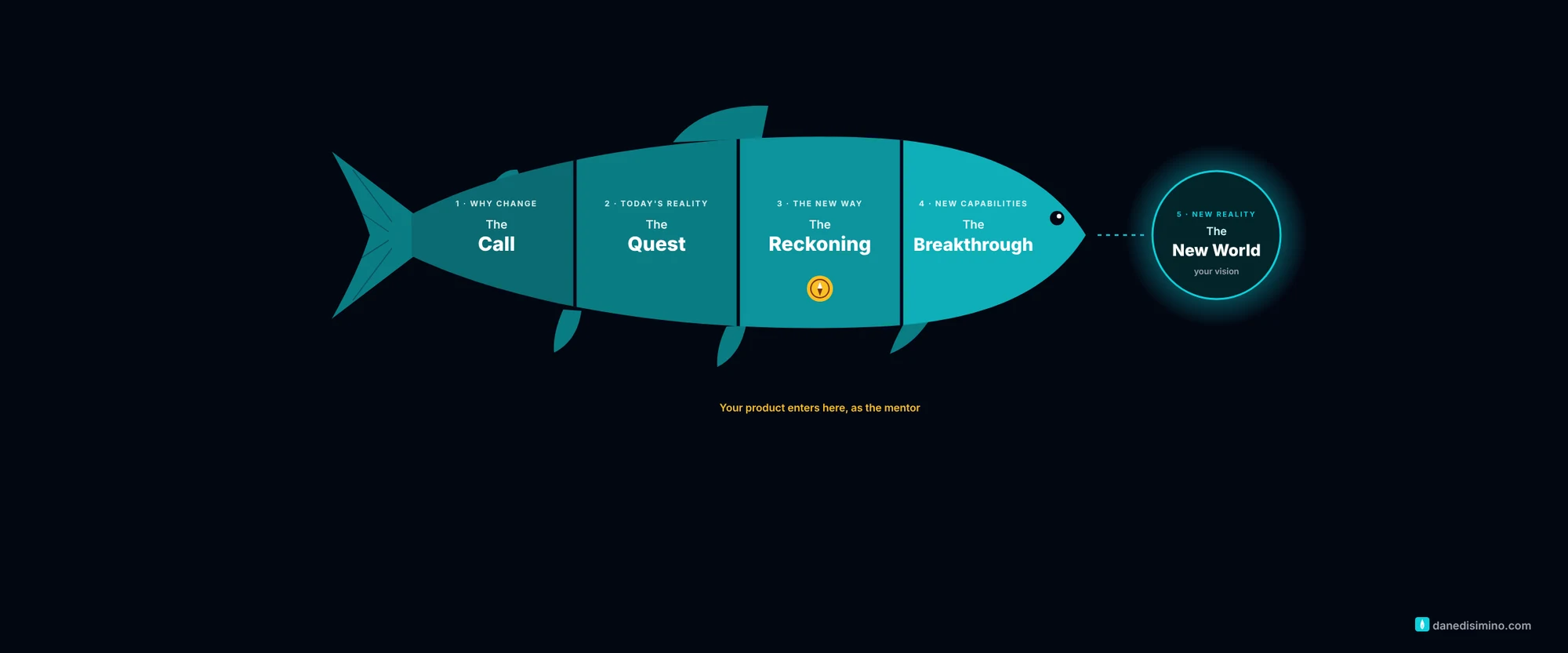
You don't need a 16-page brief. You need one page I call Narrative to Audience, or NTA. The idea isn't new; the best communicators all do it, whatever they call it. I just put a name and a simple system behind it. I draw it as a fish, because I love fly fishing. The story runs from tail to head, and the fish swims toward your vision.
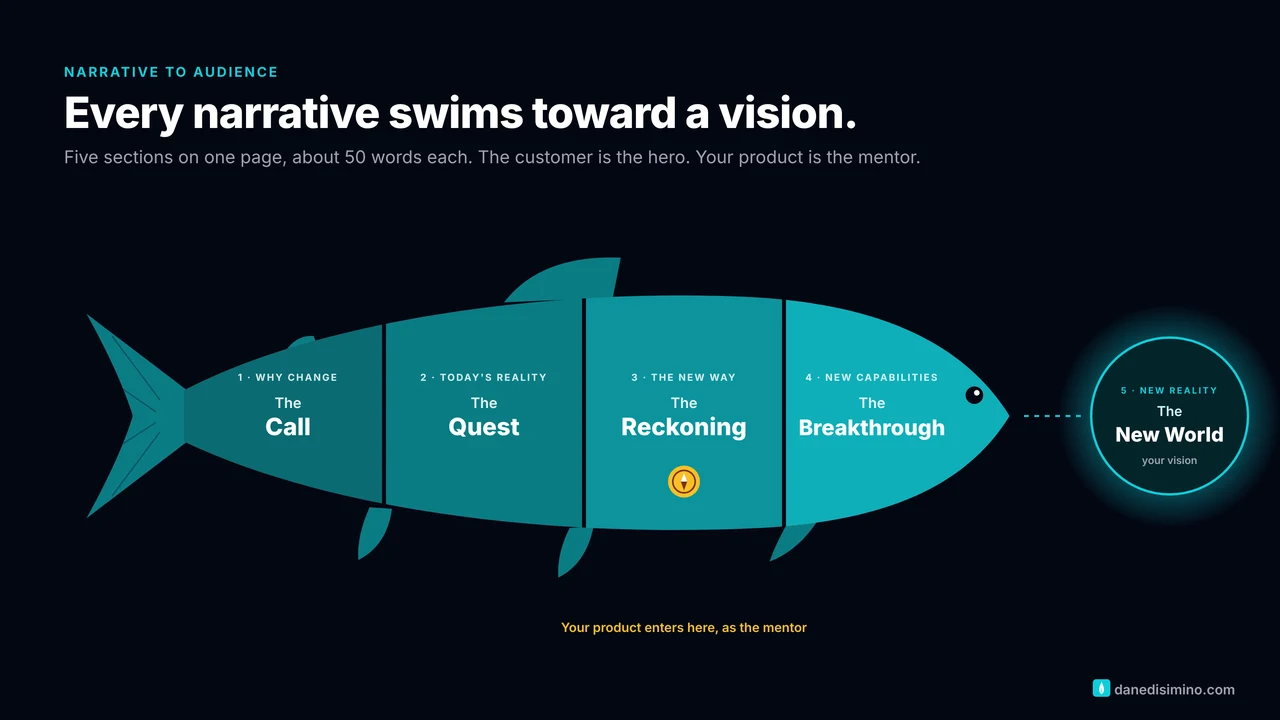
The rule: five sections, about 50 words each. Write it, test it, publish it and take it to your audience. Every format after that, from the web page and the keynote to the sales deck and the booth script, tells the same story in its own shape.
Tony Robbins is a good example. He spent a stretch going on all the big podcasts, telling the same story with different hosts in different formats. Every appearance invited listeners to his free event, the top of his sales funnel. One narrative, many audiences. That's NTA.
Worked example. Here's an NTA for a made-up security operations product, to show the shape:
| Section | What it answers | Example (about 50 words) |
|---|---|---|
| 1. The Call | What shifted in the customer's world? | Attackers now move from first access to your data in hours, not weeks. Your SOC was built for a slower world: more alerts every quarter, the same headcount, and a board asking harder questions after every breach in the news. |
| 2. The Quest | What's holding them back? | Your analysts chase thousands of alerts across a dozen tools. Most are noise. The real threat hides in the pile, and by the time someone connects the dots, the attacker has moved on. Burnout is high, and good people leave. |
| 3. The Reckoning | How does the mentor help? | [Product] puts every signal in one place and ranks it by real risk, so your team starts each shift with the five things that matter instead of five thousand that don't. |
| 4. The Breakthrough | What can they do now? | You find and contain threats in minutes. You answer the CISO's question before it's asked. Your analysts spend their time investigating, not triaging. |
| 5. The New World | What lasting value do they get? | Your SOC keeps pace with attackers without adding headcount. Your team stays. And you walk into the board meeting with answers instead of apologies. |
Notice what's missing: feature lists, version numbers and the word "innovative." Those belong further down, in the brief that backs the story up.
Make the customer the hero
Early in my career I put all my energy into the opposite. I wrote things like "Product X is an amazing tool that does awesome things." Customers read that and think, "Who cares? How does that solve my problem?" It took a long series of failures to learn the fix: frame every message around the customer's real challenge, and write it in "you" language.
| Before: the product is the hero | After: the customer is the hero |
|---|---|
| Product X is a security operations tool that analyzes data at scale to speed up response. | You'll find threats 10x faster and answer the C-suite's questions before they knock on your door. You'll be the hero of your SOC. |
| Our AI-powered platform delivers industry-leading detection. | Your analysts stop drowning in alerts and start each shift with the threats that actually matter. |
| We are the most comprehensive vendor in the market. | You replace five tools with one and stop paying for overlap. |
One more thing: you're a market and customer expert, not a product expert. You need to know the product well enough to give a basic demo and speak to its workflows. But when you start chasing version numbers and architecture details, you lose sight of the job. Lean on Sales Engineering, Technical Marketing and Product Management for that. That's what they're there for.
Positioning vs. messaging
Let's be honest. I once wrote in my newsletter: "Thirteen years in and I still can't simply explain the difference between Positioning vs. Messaging, and at this point I'm afraid to ask." Plenty of people with fancier titles than mine can't explain it simply either. So here's the simple version.
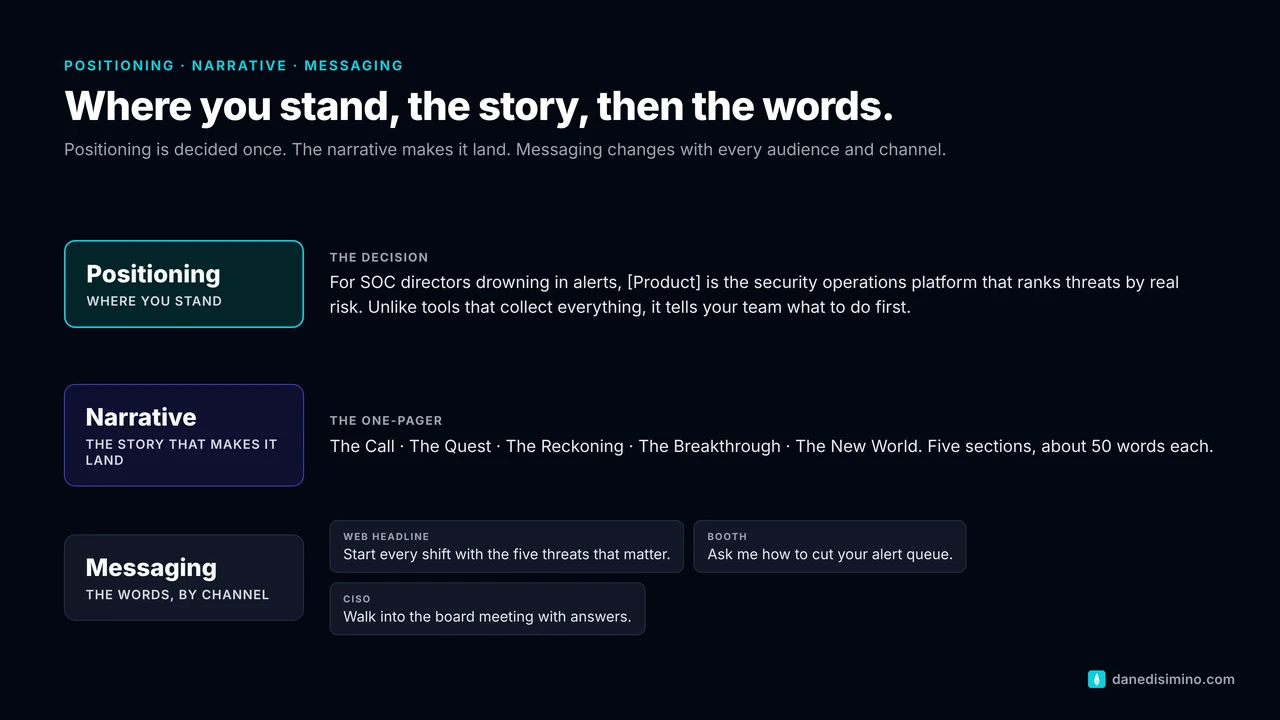
Positioning is where you stand. Messaging is what you say.
Positioning is a decision: who you're for, what you're up against, and why you win. You make it once, and it rarely changes. Messaging is the words that tell people about that decision. It changes for every audience and channel.
A solid example. Think of two cars that both get you from A to B. Volvo positioned itself on safety: for families who worry about protecting the people they love, Volvo is the car that keeps them safe. That's the decision. Everything else is messaging built on it: the ads, the crash-test stories, the showroom pitch. The words change every year, but the position hasn't changed in decades.
The same idea in tech, using the made-up security product from the one-pager above:
Behind the narrative: the lean brief
The one-pager is the source of truth. That's the whole point: one page instead of sixteen. If your teams need more detail, keep a short reference behind it, the product messaging brief. It's your message's source code. You own it, keep it current and stand behind it. When a campaign or event team asks what to say, the answer is one line: "Here's the latest messaging. Pull what you need." Without it, you'll be writing email copy Monday, booth copy Tuesday and webinar slides Wednesday until you burn out.
Keep it lean. Use whatever template your team has, or build your own from these elements:
| Element | What goes in it |
|---|---|
| Product name | Exactly as it should appear in public. |
| Tagline | What you'd say in a 15-second Super Bowl ad. |
| 10/25/50/100-word descriptions | Each one builds on the last, using the same words. These get used most. |
| Challenges | The top three customer problems, validated with users. If these miss, everything below misses. |
| Value pillars | Three headings of 5–7 words, each starting with a verb and answering one challenge, plus a 25-word overview of each. |
| Key benefits | Up to three per pillar. |
| Differentiators | Per pillar, use the Force Management approach: one unique, one comparative and one holistic differentiator. |
| Features and use cases | The details: what it does, for whom, in which situations. |
| Proof | Customer quotes, case studies and testimonials. |
| Appendix | Everything useful that isn't critical. |
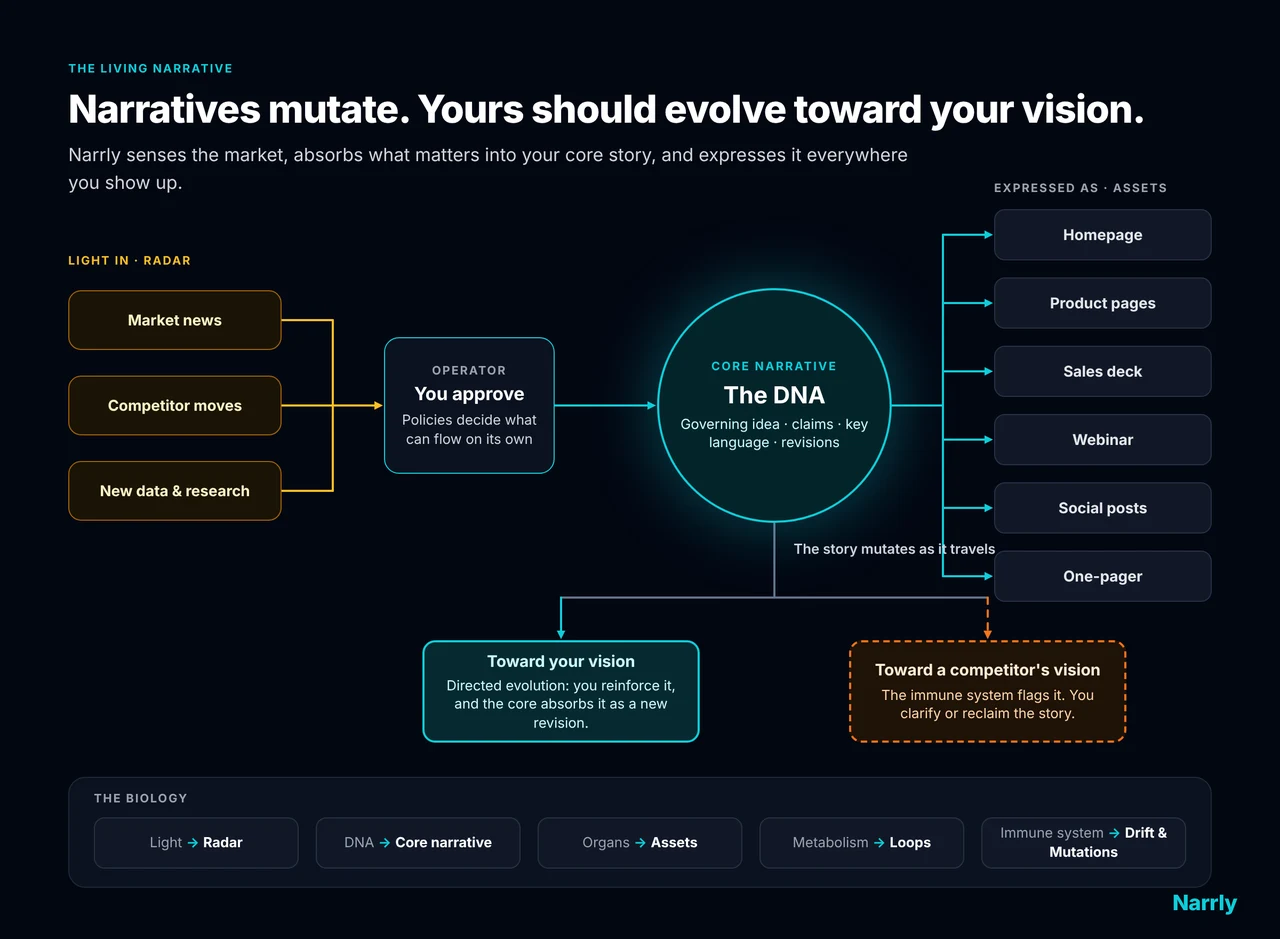
Messaging is never done. The minute you call it final, a launch or a new piece of feedback changes it. Treat it as a living document and update it without anxiety. That's why I built Narrly around the idea of a living narrative, a story that keeps up as your market changes.
When it's not a product: messaging an architecture
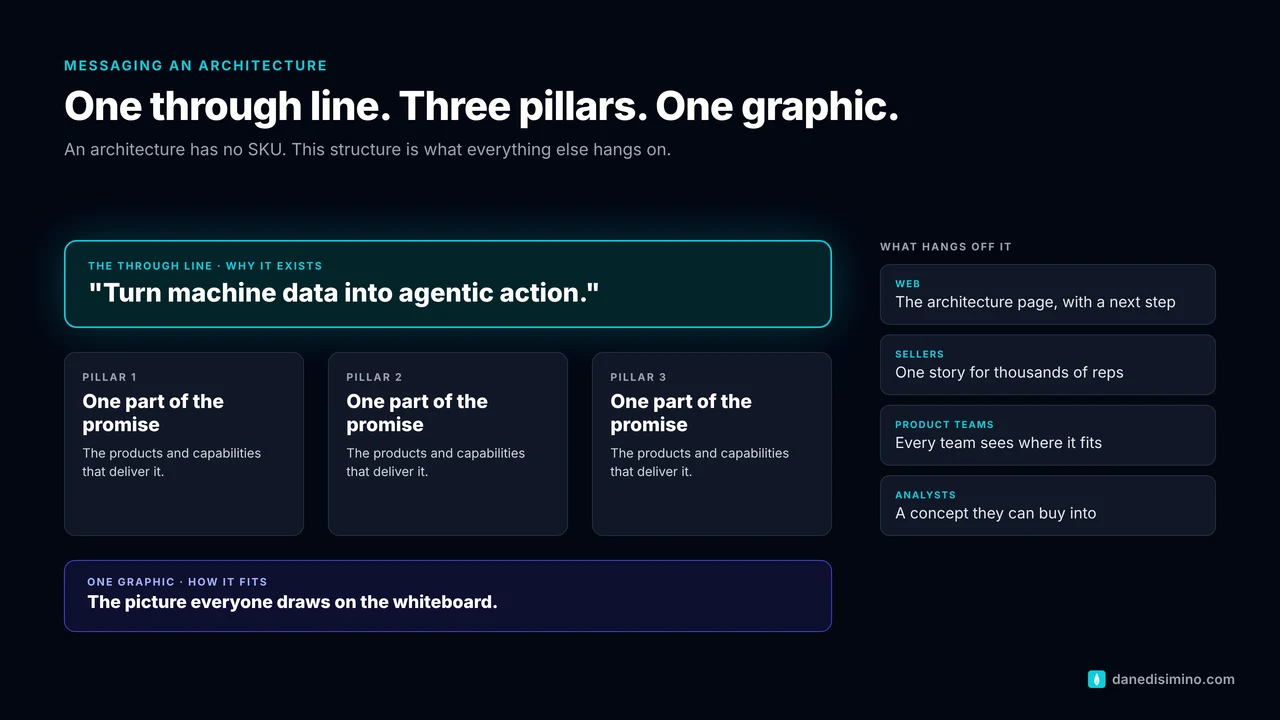
More and more, tech companies sell architectures, not single products. I recently owned the narrative for one at Cisco, the Cisco Data Fabric, and it was one of the hardest messaging jobs of my career.
The first thing everyone asks is "How do I buy it?" And the answer is that you don't buy an architecture. You buy the products that make it up. That one fact makes everything harder:
The web page. A product page sells one thing. An architecture page has to explain how many things fit together, and still give people a next step.
Sales enablement. How do you prepare thousands of sellers to talk about something with no SKU?
Internal alignment. Every product team that contributes wants its piece front and center.
Analysts. You have to brief the firms on a concept rather than a product and still win their buy-in.
What made it work: one through line, three pillars and one graphic. An architecture needs a single headline powerful enough to tie every product in it together. Ours was "Turn machine data into agentic action." Under it go three pillars, each grouping the products and capabilities that deliver one part of the promise. Then one graphic shows how it all fits. The headline answers "Why does this exist?", the pillars answer "What's in it?", and the graphic answers "How does it fit together?" Every web page, seller conversation and analyst briefing hangs off those three. Without them, we would not have succeeded.
Test it
Great messaging gets tested, and testing takes patience and humility. You don't know it all. Here's the 10-step process I've used again and again:
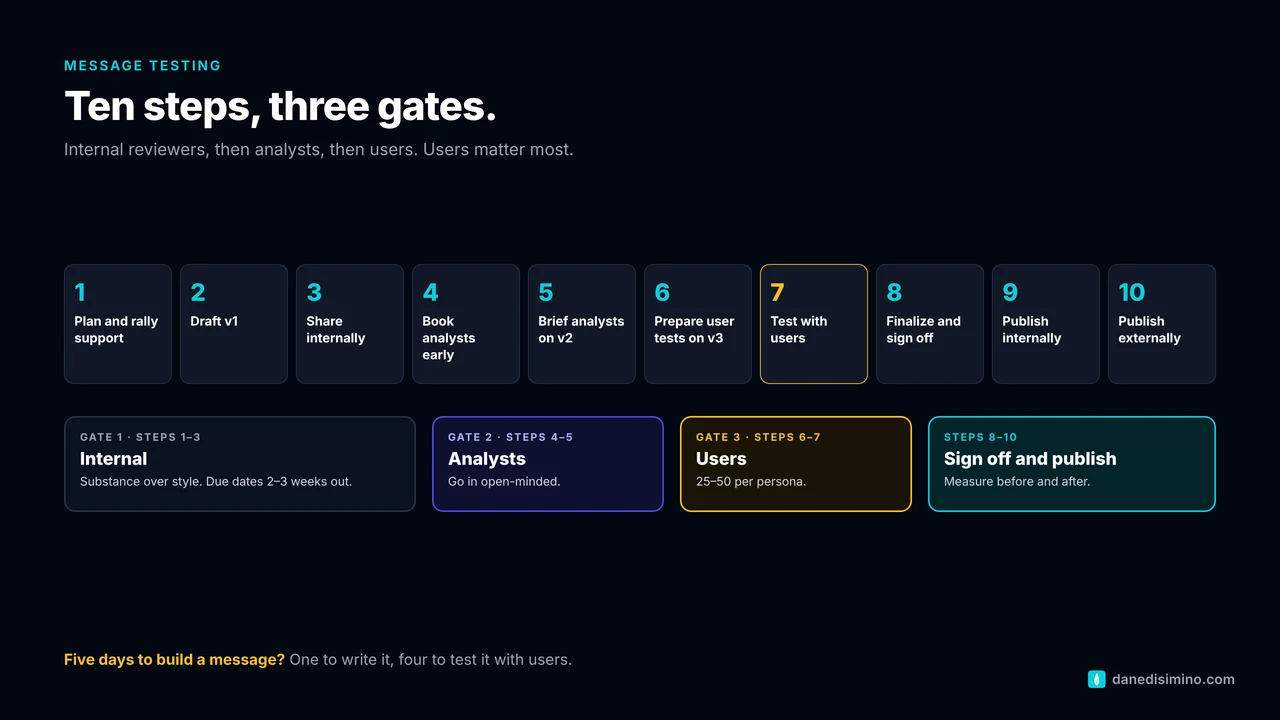
Make a plan and rally support. A simple sheet of milestones, dates and feedback groups. Share it and ask each group for help.
Draft v1. Write your NTA and brief. It'll be messy. Start anyway.
Share v1 internally. Send it to other PMMs, product managers and anyone close to customers. Give a due date two to three weeks out, never "end of day." Say exactly what you want feedback on: "Do these challenges match your recent customer calls?" Add "Please don't comment on grammar yet."
Book analyst briefings early. Analysts' calendars fill weeks ahead. Many vendor contracts include message-testing time that almost nobody uses. Use it.
Brief the analysts on v2. Send it ahead. No slides, and don't read it aloud. Cover the challenges, then the value pillars, then ask specific questions.
Prepare user tests on v3. Turn the 10-word description, pillar headings and overviews into one visual, like a landing page mock-up. Don't show users the whole brief.
Test with users. This is the step that matters most. If I had five days to build a message, I'd spend one writing it and four testing it with users.
Finalize and sign off. Send the final to every reviewer for a last call, and get executive sign-off before anything goes public. You don't want an executive derailing the project at the 11th hour.
Publish internally. Post it with links so campaign and sales teams can use it right away.
Publish externally. Refresh the web page. If you can, measure conversion before and after.
If I had five days to build a message, I'd spend one writing it and four testing it with users.
With analysts: buckle up. They see dozens of vendors a week and owe you nothing. I once watched a leading analyst take apart our message "from foundation to rooftop" in 15 minutes. My manager had insisted the message was locked and wouldn't change. I took four pages of notes, thanked the analyst, and we rebuilt it. That rebuild became the best messaging of my career. Go in open-minded. A critical analyst is a gift, because there's still time to fix it.
With users: keep it simple. Put your core value proposition and differentiation on one visual and ask two questions: "Does this resonate with you, yes or no?" and "Why? Answer in 15 words or more." Now you can say "45% preferred version A and 64% preferred version B" instead of arguing. Tools like Wynter make this easy, but even one user is better than none. Aim for 25–50 per persona, and test across personas. I once tested with 30 CISOs, 30 SOC directors and 30 analysts, and the three groups disagreed sharply. That shaped how I talked to each one.
AI can speed up the early rounds. You can now simulate how buyers react to a message with AI, in minutes instead of weeks of surveys. Use it to sharpen drafts before they reach real users, not instead of them. Once the message is live, AI earns its keep as a governor.
The best part of testing is that you get data to decide with, instead of being bullied by the loudest voice in the room.
Govern it
Publishing the message is the start, not the finish. In a big company, dozens of teams turn your narrative into decks, pages, posts and scripts every week. Each one bends the story a little. Left alone, the story drifts.
Put a narrative governor in place. With tools like Claude or Codex, you can now build an agent or skill whose only job is guarding the story. You load it with the latest executive-approved narrative and the vision behind it. Then it checks the work across your teams, workstreams and deliverables, and flags anything that drifts off message before it ships. It's become one of the most powerful weapons I have in the war against bad messaging.
This is also the idea behind Narrly: a living narrative with a governor built in.
Everyone's a critic
As the messenger, expect everyone in the company to think they could do your job better. Product managers will skip your review and then disagree. Sellers will ignore the messaging and write their own. The brand team will flag your Oxford comma. And you'll hear these, guaranteed:
"It's too complex." / "It's not technical enough."
"It isn't differentiated." / "Our competitor says the same thing."
"Make it simpler." / "This is too simple."
"Be more creative." / "Say exactly this. That's an order."
I've been through messaging projects that ran six months, with more than 40 reviewers, several analyst firms and more than 100 user reviews. Sometimes a senior leader will still change it for political reasons. That's the job.
Watch for the executive tagline. In big companies, one executive can float an idea in one meeting. Nobody tests it with customers. Suddenly it's the tagline in a keynote, and the PMMs spend the next two years defending it, without anyone remembering where it came from. When an idea like that lands on your desk, find out where it came from, and put it through the same user test as everything else. Data gives you a respectful way to push back.
Keep the pen. When Thomas Jefferson drafted the Declaration of Independence, Ben Franklin, John Adams and others all had edits. Jefferson took them, compromised where it served the whole, and kept writing. Do the same. Don't be autocratic. Listen to every group without losing your patience, work the process, and keep the pen.
When the narrative is clear, everything else follows. That's the messenger's job.
Next step
Narrly turns this whole process into software. You build your Narrative to Audience one-pager and take it to every audience and channel from one place, with a governor that keeps every draft on the story you approved.
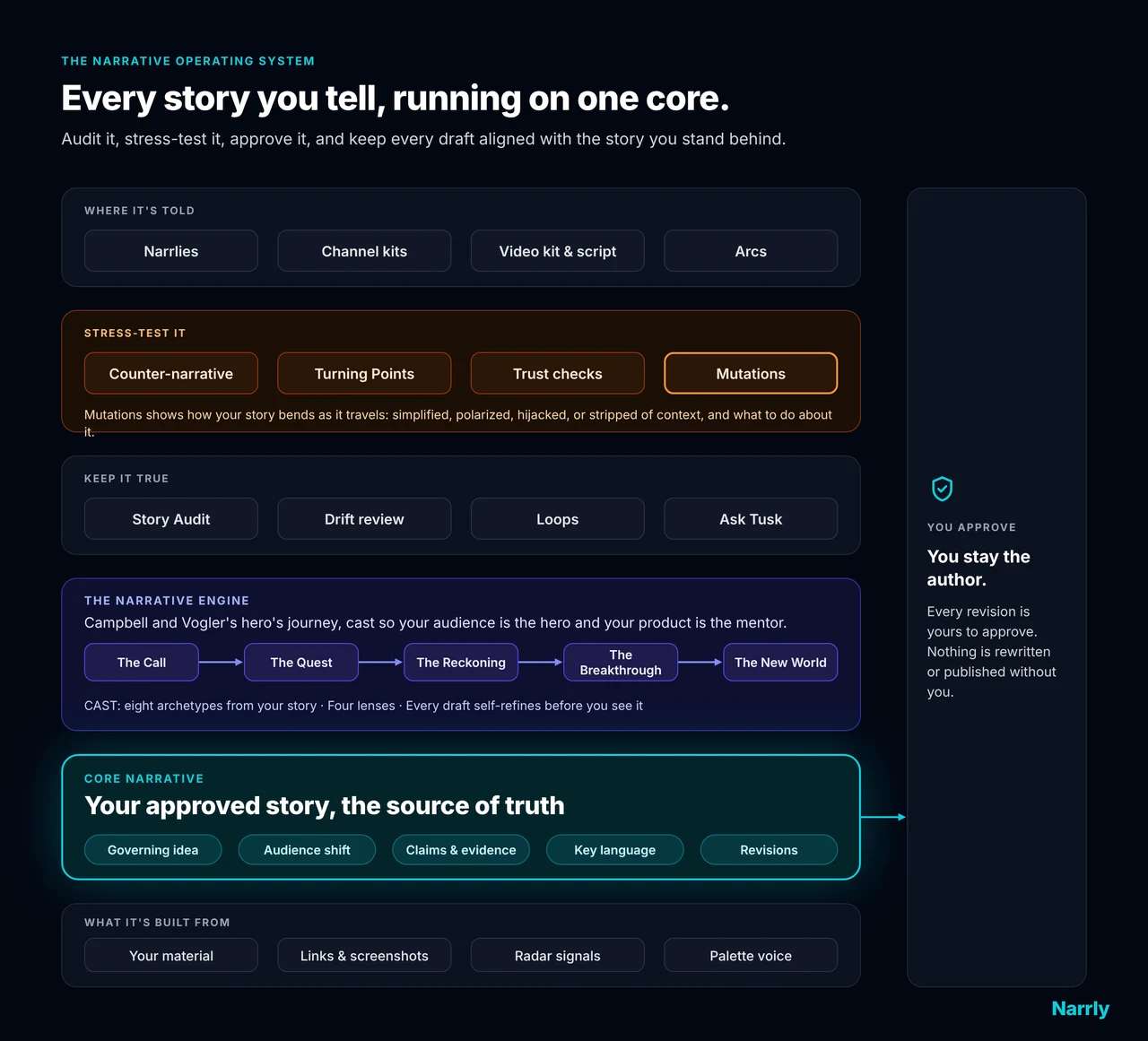
Want a free audit of your narrative? Run it through Narrly's Story Audit at narrly.ai and see where your story is strong, where it drifts, and what to fix first.
Pathlight
Practitioner notes on narrative and launch, with templates when they are ready.