

PRODUCT MARKETING
Product Launches
A Product Marketing Guide
On this page
How to run a product launch that the market notices: pass the AI test, clear six non-negotiables, tier every launch, plan for the GA date to slip, bundle releases into marketing moments, and measure adoption, not launch-day noise.
Version 1.0 · Updated Nov 10, 2026
New to cyber product marketing? The free Cyber PMM Academy covers the fundamentals in twenty modules.
I've survived a lot of product launches: more than 100 across 12 years. I led some and supported many more; this coming quarter alone I'm part of 10. Some were triumphs. Others I've erased from my memory. Along the way I learned there's a method to the madness, but it's not the one most launch playbooks teach.
Start with an uncomfortable truth: most launches don't land. Estimates of how many new products fail run as high as 95%, and the more careful studies average around 40%.
Launching isn't the hard part. Launching something the market notices is.
Half the battle is having a product that works, does something new and has a real audience waiting for it. Some products market themselves; when the PlayStation 5 came out, Sony couldn't build them fast enough. Most of us don't get to launch the next PS5. So we guide our product and engineering friends to market, and this guide is how I do it now.
Note: this guide is written mainly for corporate product launches in complex, team-based environments, not for solopreneurs vibe coding a new app.
The short version
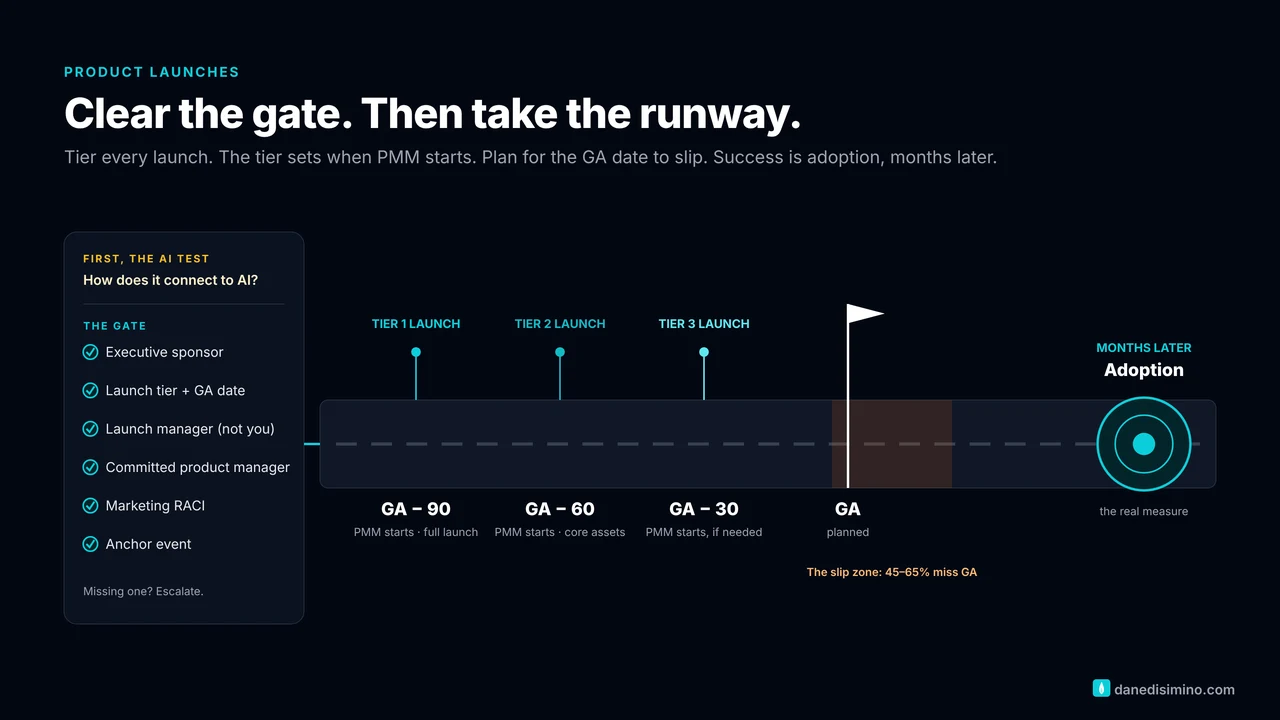
No tier, no work. Every launch gets a tier before you commit a single hour.
Six non-negotiables. An executive sponsor, a launch tier and GA date, a launch manager who isn't you, a committed product manager, a marketing RACI and an anchor event.
One page. Put the whole launch on a single Plan-on-a-Page slide and keep it current.
Don't trust the GA date. Most launches miss it. Plan for the slip, but be ready if it ships on time.
Bundle into moments. For a big portfolio, group releases into a few marketing moments a year that the market actually notices.
- 100+
- Launches across 12 years
- 6
- Non-negotiables before you say yes
- 65%
- Missed GA in my launches
- 90/60/30
- Days out: when PMM starts, by tier
First, the AI test
AI has put the whole technology industry into survival mode. This is a once-in-a-generation shift, and buyers measure every launch against it. So before tiers, plans or GA dates, ask one question: how does this launch connect to AI? If it doesn't, go back to the drawing board.
Put my cybersecurity hat on and it's even starker. AI models like Anthropic's Claude Mythos are now finding software vulnerabilities faster than defenders have ever seen. A security launch that doesn't address securing AI and agents is already irrelevant. The same goes for every other technology category.
Before you say yes: the 6 non-negotiables for any launch
I've seen it all: launch processes with enough checkboxes to make your eyes bleed, and processes so thin they skip cross-functional alignment entirely. If you're a solo PMM at a startup, scale this down. For everyone else, here are the non-negotiables.
An executive sponsor. Without someone upstairs who cares, the launch will fail.
A launch tier and a GA date. Decided by a tiering gate before you're pulled into meetings (more on tiers below).
A dedicated launch manager, and it isn't you. A program/project manager runs the plan, hosts the calls, takes the notes, tracks every function and escalates risks to the sponsor. Without one, you become an ineffective launch manager while still doing all your marketing work. That's a recipe for burnout.
A committed product manager. You need a visible, engaged PM who can vouch that engineering will deliver, and a product requirements document that explains why this product, why now. Without it, you're marketing on quicksand and taking orders.
A marketing RACI. Who is Responsible, Accountable, Consulted and Informed for each marketing task. In a big company, get your leader to bless it. Otherwise you'll be the catch-all for everything from the press release to sales enablement.
Use an anchor event. Use a major event like an industry conference or a user conference to anchor the launch to. It is the best way to rally teams and get executive buy-in. Pro tip: make sure it's expected by a high-ranking executive by adding it into his or her keynote. This is a way PMM can influence engineering teams to deliver and ship the product on time.
The launch that never shipped
I learned this the hard way. Early in my career, I was asked to run a major launch for a new solution that promised to unify a set of separate technologies. Everyone agreed it was a great vision, exactly where we needed to go.
But there was no executive sponsor behind it, and the leaders in product and engineering weren't committed. I took the product manager's word that it would ship. Later I discovered deep division inside the product organization about whether this product should exist at all. The product team also insisted on its own GA date and fought anchoring the launch to an industry event, which made every program call tense. And because the program manager came from engineering, I got pulled deep into engineering mechanics that had nothing to do with marketing. It drained me.
I still rallied the teams behind a major marketing moment. Every piece of the marketing machine was in place. Then engineering missed the date. The whole effort was wasted, and it confused the field. The process took about a year, and at the end of it, the product still hadn't shipped.
What I took from it:
Get an executive sponsor in early, someone who stands behind the release.
Draw a line in the sand. Before you put the marketing machine behind a major release, make the product and engineering executives commit to it.
Use a marketing program manager for marketing programs. An engineering program manager will run it like an engineering project.
A great vision isn't a product. Sellers can't sell a vision that doesn't work yet.
Launch tiers
Not every launch deserves the same effort, and your time is valuable. A tiering gate weighs each launch on revenue impact, regional availability and strategic fit, then assigns a tier. Don't join launch planning until it has one.
| Tier | What it is | When PMM joins | What PMM delivers |
|---|---|---|---|
| Tier 1 | A new product or major capability with big revenue impact or strategic weight | 90 days before GA | The full launch: messaging, analysts, web, content, demo, enablement, webinar, PR support |
| Tier 2 | A meaningful new capability for an existing product | 60 days before GA | Messaging update, web page, product brief, demo, enablement, blog |
| Tier 3 | A minor release or maintenance update | 30 days before GA, if at all | Release notes, a community post, a Slack announcement |
Running the launch
Say the stars align and you have all six. Now what?
Scrub the project plan. Read every line that lists Product Marketing as the owner. Launch managers often copy and paste the plan from the last launch without asking what this one needs. Book a one-on-one with the launch manager and give your honest read: the market research you've done, what analysts are saying, your view on the tier and the PRD. Marketing is often treated as a bystander in tiering, so represent marketing's view. Then cut what doesn't fit. I've told plenty of launch managers, "No, I'm not doing that for this launch," and they usually are grateful you're even paying attention. You're the expert.
Why it matters: early on, nobody else in marketing has tasks on the plan. Wait two to four weeks and someone asks, "Where are we with the press release?" Everyone looks at you, because you're "marketing." Connect the launch manager to each marketing lead through the RACI early, so you aren't speaking for everyone.
Your secret weapon: the Plan-on-a-Page
Put the whole launch on one slide. I call it the POAP (it rhymes with "nope"). It holds:
Launch tier
What's being launched
Differentiation
Launch objectives
Metrics for success
Timeline (people love a timeline across the top)
Go-to-market strategy
Activation plans and anchor event date
Use Claude or Codex to build it based on everything you know. Share it early and keep it updated as things shift, because they will. It aligns the marketing teams, and it's ready the minute an executive asks for a briefing.
The GA date myth
Of the 100-plus launches I've been part of, I'd guess at least 65% missed their original GA date. Gartner found 45% of launches slip by at least a month. Product and engineering teams are optimists about ship dates; it's practically a law of product marketing. Sadly, I recommend you plan for failure, not success.
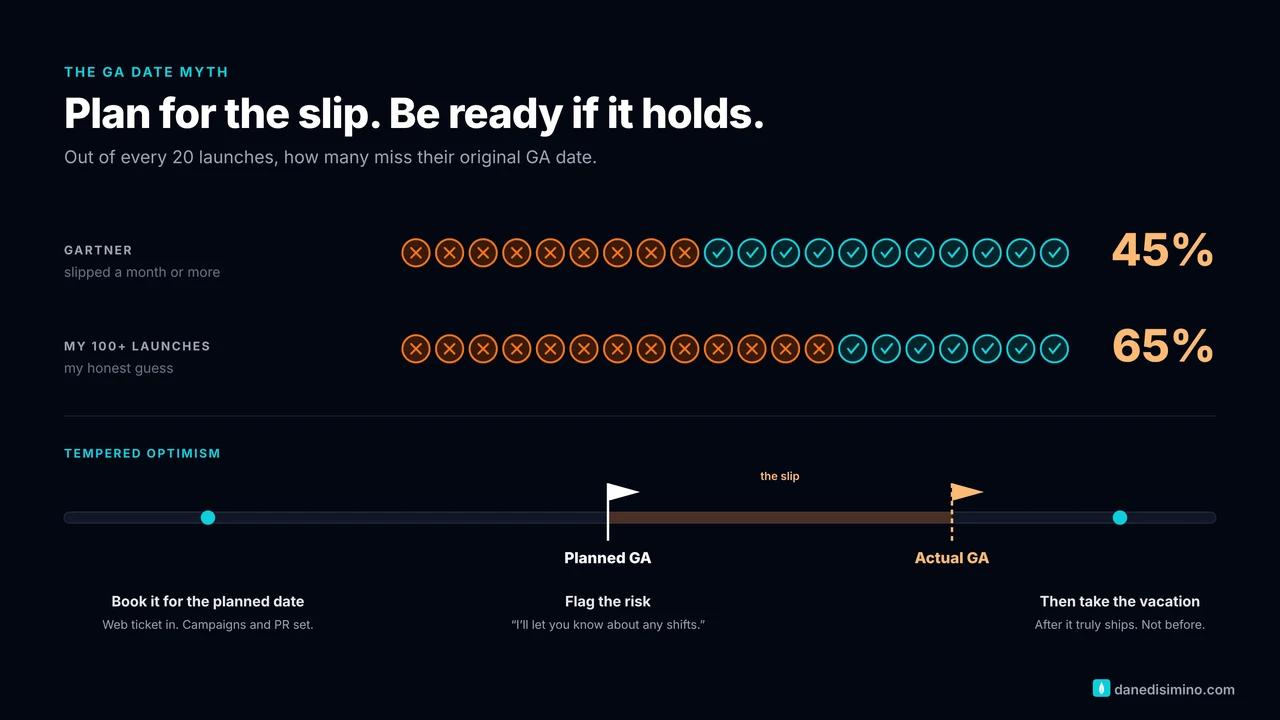
My approach is tempered optimism. It's tricky. Stay a team player, but don't rally every go-to-market team too early. And never be the PMM who misses a GA date that actually holds. In practice, I submit the web page ticket for the planned date, then message the web team: "I'll let you know about any shifts." Do the same with campaigns and PR. You're the risk manager, with your ear to the ground with product, and the first to tell everyone when the date moves.
The launch checklist
For a Tier 1 launch, here's the baseline. Lower tiers drop items as they go.
Publish the messaging (narrative one-pager and brief)
Brief analysts and fold their feedback into the messaging
Share the Plan-on-a-Page across marketing
Map the buyer's journey and get sign-off from campaigns and creative
Get official screenshots from creative
Publish the web page, new or updated
Publish a two-page product brief or data sheet
Publish a deeper white paper (six to eight pages)
Publish a five-minute demo video built around a use case
Update the field enablement page
Run a webinar with your PM: longer demo, live Q&A
Commission sponsored analyst content (often lands after launch)
Update product blurbs across the website
Share the internal and external communications plan, with dates and RACI
Publish an internal screenshots folder
Produce a 30-second social video
Post the Slack announcement across channels
Publish a community blog post for current customers
Ghostwrite an executive blog post
Add a customer testimonial from the preview phase
Fact-check the press release
Build and present theater presentations for the anchor event
Include the launch in anchor event keynote decks
Anchor events and marketing 'moments'
In a big portfolio, single launches get buried, under competitors' noise and under your own scattered announcements. Marketing moments fix that. Instead of releasing products like confetti all year, you group them under one theme a few times a year. Think four moments, each one a rallying cry for the whole team, usually anchored to an event the market already watches. Here is a textbook cybersecurity industry example:
RSA Conference (April)
Gartner's Security and Risk Management Summit (June)
Black Hat (August)
Your own annual user conference (September)
A major cloud provider event, like AWS re:Invent (December)
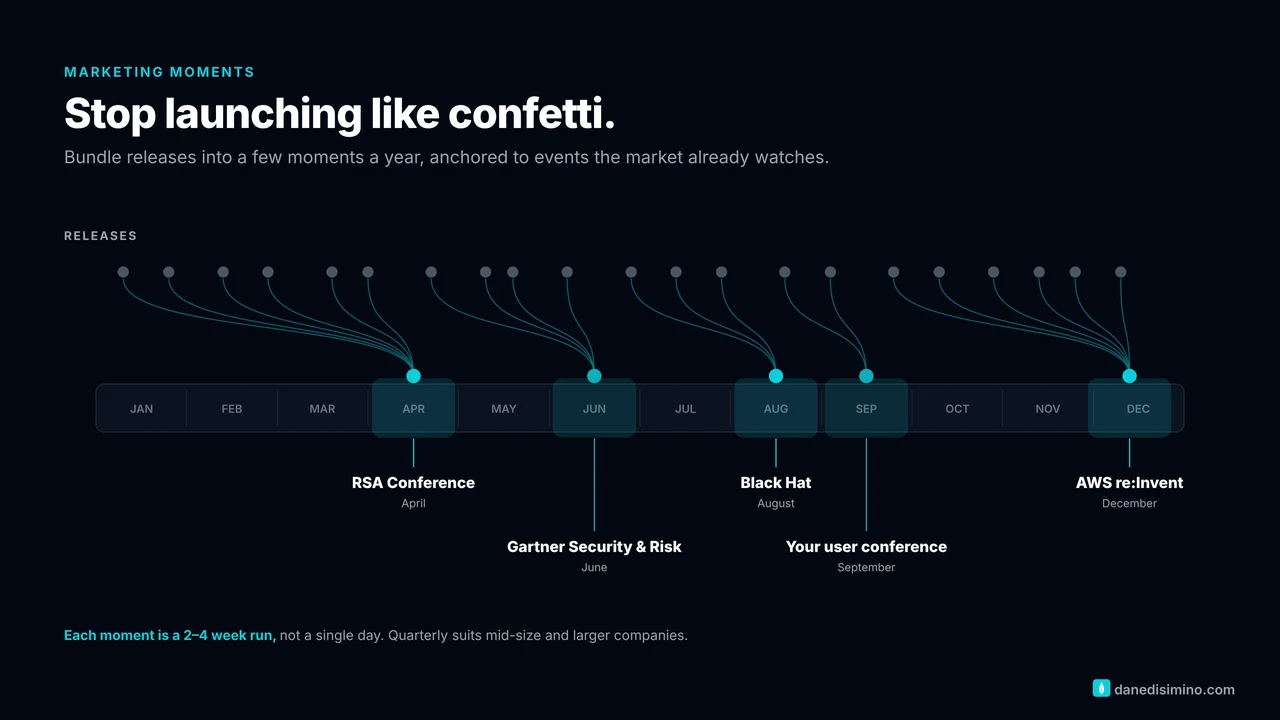
A moment isn't a single day. It's a run of activity across marketing, often two to four weeks, built around the event. And unfortunately you sometimes will have overlapping events, but in that case you can just replicate your activations across both.
Quarterly is ideal for mid-size and larger companies. Smaller companies may not have that luxury; they're often shipping updates to one product far more often. Even the AI labs, which ship big model updates every few weeks, still save their biggest news for anchor events like developer days, and NVIDIA builds its year around GTC. However fast you ship, the anchor events still matter.
What it takes:
A program manager who understands several business units, not just one product. In other words, the product launch manager usually sits in engineering, and is responsible for engineering and GA dates. They usually just treat marketing as an afterthought. But the 'marketing moment program manager' sits in the marketing org, and manages cross-functional marketing teams for a powerful force.
An executive sponsor in a chief's office. If one marketing team owns it, you won't get campaigns, creative and PR to line up behind it.
An executive who sells it to the other executives, including product and engineering, so everyone knows the priorities for the quarter.
Where it gets messy: product teams think in releases, not market stories. And once "marketing moment" enters the room, people ask, "Is this a launch or a moment, and what's the difference?" Here's how I explain it: you're still launching their product. The moment is how their launch gets the whole go-to-market engine behind it. "Help me help you" works here.
Making it work:
Run the "So what?" test. For each theme, ask why customers should care. If you can't answer in one sentence, rethink the theme.
Set clear roles. The program manager owns a RACI for every moment.
Standardize the process. The same timeline, deliverables, checkpoints and templates every time.
Review together, often. Weekly or biweekly check-ins with every team involved.
Prioritize by business impact. Not every release gets equal billing. PMM leadership picks the headliner, based on strategy, revenue and differentiation.
Hold a post-mortem after each moment, and improve the next one.
Be patient. Sometimes your product isn't the headliner. If it deserves more, that's a conversation for executives to have. Their job is to set the priorities everyone else aligns to.
Without executive leadership and a program manager, marketing moments become frustrating exercises where nobody understands the why, who, what, when or how. Done right, they bring order to the chaos and let the company tell one story the market actually hears.
Shipping every week: SaaS releases
More and more software ships continuously from the cloud, updated every few weeks or even every few days. Product marketing has to keep up without treating each release as a launch.
Train a faster muscle. Speed up the small stuff: community updates, social posts, web page tweaks for new features, and Slack announcements, without five rounds of approval. If you don't build this muscle, you'll get left behind.
Save launches for moments. Let the weekly releases flow as Tier 3 updates, and bundle the meaningful ones into your next marketing moment.
Don't market against yourself. When a cloud version joins a product that used to be on-premises only, the field will ask for comparison slides. Push back. Help sellers consult instead: if a customer's CIO is moving everything to the cloud, the cloud version is an easy conversation. If the customer wants to stay on-premises for good reasons, support them. Put the customer first, not the commission.
Measure it
Let's be honest: you can't call a launch a success on launch day. Page views, press pickup and a good webinar turnout tell you people noticed. They don't tell you it worked. A launch succeeds only when time has passed and real users have adopted the product or capability.
So set the adoption goal before launch day, put it on the Plan-on-a-Page, and come back to it in a few months. Until then, celebrate the work, not the win.
The bottom line
Launching products is a product marketing superpower. It takes planning, coordination and cross-functional diplomacy, and communication is your greatest asset. Your real value isn't checking boxes. It's bringing market research up front and testing the launch plan against what the market actually needs. That's how a product release becomes a market event worth talking about.
There's no exact science to a successful launch, but there are ways to raise your odds. That's the art.
Next step
Every launch starts with a story the market cares about. Want a free audit of your narrative? Run it through Narrly's Story Audit at narrly.ai before your next launch.
Sources
Pathlight
Practitioner notes on narrative and launch, with templates when they are ready.