

PRODUCT MARKETING
Cyber Markets and Buyers
A Product Marketing Guide
On this page
Who actually buys cybersecurity, how they decide, and what pressure they're under. Segmentation past the industry label, personas worth building, the eight-person buying committee, and how to get at the buyer data your company already has.
Version 1.0 · Updated Nov 21, 2026
New to cyber product marketing? The free Cyber PMM Academy covers the fundamentals in twenty modules.
Everything in product marketing eventually runs into the same chain. We market products. Products need buyers. Buyers sit inside companies. Companies sit inside markets. Markets add up to an industry.
Most of us start in the middle of that chain, writing for a product, and never work our way out to the edges. Then a seller asks who the product is for and the answer comes back as a job title. That's not an answer.
This guide is how I work down the chain now, after thirteen years across seven cyber vendors: from an industry nobody can address, through segmentation that actually narrows something, to the handful of people who will decide whether your deal closes.
The short version
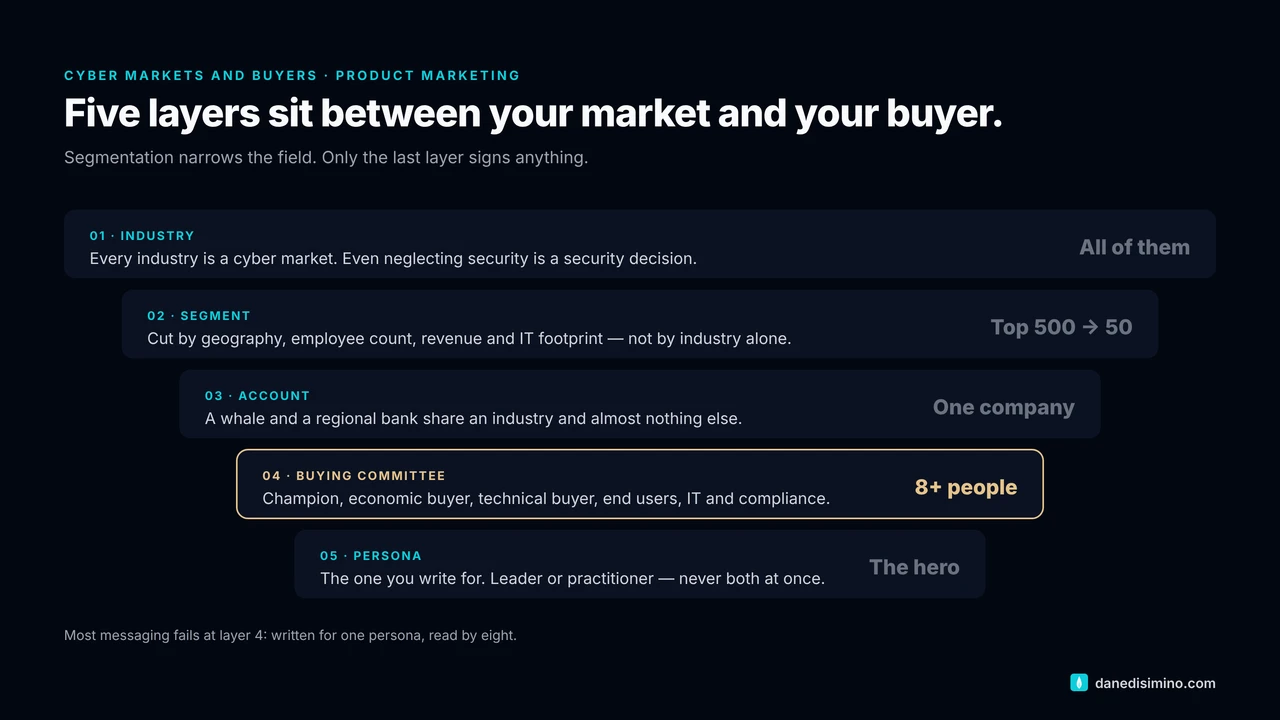
Every industry is a cyber market. Even deciding to neglect security is a security decision.
An industry label is not a segment. Geography, headcount, revenue and IT footprint are what narrow it.
Build personas for leaders and practitioners separately. They have different problems, different sources, and different reasons to care.
Nobody buys alone. Expect eight or more people, including names from IT and compliance you didn't plan for.
Your buyer data already exists inside your company. It's in win/loss notes, the CRM, and your sellers' heads.
- 5
- Layers between market and buyer
- 8+
- People on a typical buying committee
- 2
- Persona families: leaders and practitioners
- 4
- Business days to disclose a material incident
Start wider than feels useful
At thirty thousand feet, every company has IT to protect and someone, however unofficially, making decisions about it. That someone might be one person wearing fifteen hats at an eight-person business in Tulsa, doing security on the side. It still counts.
I used to wonder whether any business was genuinely outside this. Then I hired a contractor to rebuild my backyard fence. Everything he did was with his hands. We arranged all of it over email, and I paid his invoice through a card link he sent me. At year end he'll save a tax PDF to a laptop. You can argue the security burden sits with Google and the payment processor, and you'd be partly right. You cannot argue he's outside the digital economy.
So assume every industry is a potential market. Financial services, healthcare, manufacturing and retail differ enormously in the particulars, but none of them are exempt. That's the starting width. Now narrow it.
Segmentation is what narrows it
An industry is not a segment. "We sell to financial services" tells your sellers nothing they can act on, because JP Morgan Chase and a regional bank three states over share an industry and almost nothing else. Targeting the whale is a different motion, a different cycle and a different conversation than targeting the regional.

So add the dimensions that actually separate companies:
- GeographyWhere the industry concentratesRegulations differ by country. The need doesn't — every country has a banking system that has to be secured.
- SizeEmployees and revenueThis is what separates the top five from the top five hundred inside one industry.
- IT footprintWhat they actually runThe best proxy for their security problems.
- FitWhere your product landsWhich segment is most likely to adopt, not which you'd like to win.
That fourth line is the one people skip. IT footprint tells you more about a prospect's security problems than their industry does. How many devices do they manage? Which enterprise apps — Salesforce, Workday, Microsoft 365? Cloud, on-prem, or stuck between? How big is the security team, and have they outsourced to an MSSP or MDR? What are they already running for identity, endpoint, network and SIEM?
Winning one segment tends to open the next. A beachhead with a few happy financial services customers improves your odds in financial services, and then opens insurance and legal, because the proof points travel. That's the bowling pin model, and in cyber it's usually how growth actually happens — one adjacent pin at a time, not a broad push.
Two persona families, not one
Once segmentation is settled, work out who you're writing for. In security there are fewer roles than you'd expect, and they split cleanly into two families.

Leaders carry titles like CISO or VP of Information Security. (It's pronounced "see-so." Not "sizzo." I won't hold it against you, but I'll notice.) They answer for risk, budget and the board.
Practitioners are SOC directors, security analysts, engineers, architects and incident responders. They answer for whether the thing works at two in the morning.
For each one, I build out the same sections: key challenges, objectives, reporting structure, who influences them, where they get information, what content they need, budget authority, and technology needs.
Three reasons this is worth the hours. Your sellers need to know who they're talking to before they open their mouths. You cannot write messaging without knowing whose story it is — every great ad you remember was aimed at somebody specific. And your campaigns and content have to serve each persona's actual needs, because by the time anyone talks to a seller they've already done most of their research alone.
What's actually pressing on them
Personas are a shape. Motivation is what fills them.

The CEO asks the CISO one question: are we safe? Underneath it sits a chain nobody says out loud. Looking insecure costs trust. Lost trust costs customers. Lost customers cost the CEO their job. That's the engine under most security spending, and it runs on fear more than ambition.
The second question is compliance: are we exposed to fines? As penalties have grown, that's moved from a back-office concern to a board-level one.
And the stakes on the individual have risen sharply. CISOs increasingly report to the CEO in practice, whatever the org chart says, because boards want direct answers and CIOs can't track security in enough detail to give them. When a breach hits the news, the CISO is the one in the room explaining exposure that same week.
When you write for a leader under that kind of pressure, "increase visibility" is not a value proposition. "You will be able to answer the board on Thursday" is.
Nobody buys alone
Here's where most messaging quietly fails. You write for one persona. Eight people read it.

A security purchase runs through a committee: a champion who wants it, an economic buyer who funds it, technical buyers who judge it, end users who'll live with it, and leaders from IT and compliance with opinions and veto power. Don't discount the IT and infrastructure names — they influence security purchases more than their titles suggest.
The committee is buying a stack, not a product. Services, SIEM, endpoint, email, cloud security, identity and access, network, SOAR. They'll frame their strategy against something like the NIST framework, and they'll use analyst reports to build a shortlist. Then comes the RFP, the comparison calls, and a flood of feature questions.
They're also asking peers, reading your website, sitting through demos, weighing cost against a budget that was set before they met you, and wading through everything every vendor in the category has published. Then, if they switch, they face a migration between two different systems with two different interfaces and a team that has to relearn both.
That pain is real, and most vendor messaging ignores it. Empathy about the cost of switching wins more deals than another feature slide.
Get at the data you already have
You don't need to commission research to learn buyer behavior. Most of it is already inside your company.

Win/loss reporting, where it exists. In my experience it's rarely enforced or well structured, and getting at it means some detective work in the CRM. Go in with low expectations: sellers are busy selling, and unless their managers require notes, the notes won't be there.
Sales surveys. A ten-question survey on which features win deals, which lose them, and which content sellers actually use will tell you more in a week than a quarter of guessing. You can't sit on calls all day, so automate the asking.
Your own telemetry. If you know the addressable size of your market, measure how much of it you hold. That single ratio tells everyone whether there's room to grow.
Then use the data when you ask for things. A Jira ticket that says "we need a ransomware asset" gets queued. One that says "74% of sellers told us buyers ask how we handle ransomware in financial services and can't find the answer" gets built. Same request, with a reason attached.
What this comes down to
Segmentation is not a slide you make once. It's the thing that decides who your sellers call, what your content says, and whether anyone recognizes themselves in your message.
Start wide enough to be honest — every industry is a cyber market. Narrow on the dimensions that separate companies rather than the label that groups them. Write for one persona at a time, knowing seven other people will read it. And remember the person you're writing for is answering for risk with their own name attached.
Get that right and the rest of product marketing has something to stand on.
Next step
This guide gets you to who you're writing for. Narrative, Positioning and Messaging is what you write once you know.
Sources
Pathlight
Practitioner notes on narrative and launch, with templates when they are ready.