

PRODUCT MARKETING
Cyber Vendors
A Product Marketing Guide
On this page
How to read a cybersecurity vendor from the outside and from within. Why the industry keeps almost no secrets, what every vendor has in common, and the two things that genuinely differ: ownership and culture.
Version 1.0 · Updated Nov 21, 2026
New to cyber product marketing? The free Cyber PMM Academy covers the fundamentals in twenty modules.
I've worked for seven cybersecurity vendors in thirteen years: Comodo, Optiv, Secureworks under Dell, Siemplify before Google took it, VMware before Broadcom, Splunk before Cisco, and Cisco after it. Startups, scaleups and a Fortune 50, with two acquisitions and a global pandemic in the middle.
Seven out of several thousand is not a representative sample. But competing against the rest of them, day in and day out, for the same customer mindshare teaches you something a sample wouldn't: how alike they are, and the two places where they're not.

This guide is how to read one — whether you're deciding to join it, competing against it, or trying to work out why the last three months have been so hard.
The short version
The industry keeps almost no secrets. Everything you need to know about a competitor is already public or already in the building.
Vendors are structurally near-identical. Same forces, same budgets, same org shapes, same show floor.
Ownership is the first real difference. Public buys you structure and slowness; private buys you speed and confusion.
Culture is the second, and the bigger one. It's set by founders, funding and leaders — never by a values poster.
Your influence is the customer's voice. It's the one thing in the building nobody else owns.
- 7
- Vendors in thirteen years
- 2
- Things that genuinely differ
- 0
- Secrets that stay secret for long
- 1
- Voice nobody else in the room owns
It isn't as secretive as it looks
New PMMs assume competitor intelligence is hard. It isn't, for three reasons.
It's an incestuous industry. You don't have to look far to find someone in your building who worked for a competitor, or someone about to leave for one. It's a revolving door, and the result is that most vendors already hold a fair SWOT on their rivals. There are fewer information secrets between information security companies than you'd think.
The same analysts talk to everyone. One set of people at the big firms briefs every vendor in your category, collects the data, and publishes a view of where each one stands. If your company licenses the reports covering your market, read them. Knowing your market is foundational to the job, and this is the cheapest version of it.
Vendors are loud about anything resembling a differentiator. Their website, their LinkedIn page, their demo videos, webinars, booth scripts and financial disclosures are a gold mine. The information is sitting there. The only scarce resource is your time to go and read it.

What every vendor has in common
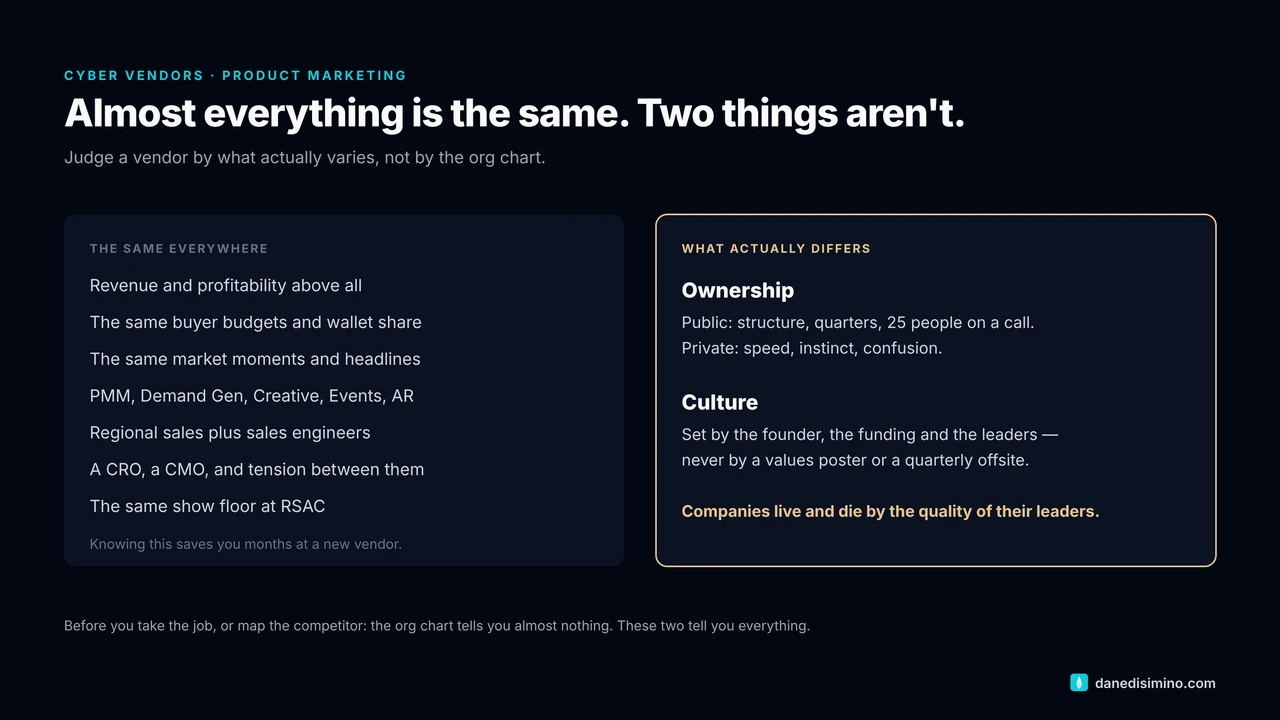
Revenue and profitability drive everything; the rest is built around that. Beyond it, the similarities run deeper than most people expect.
The same buyer budgets. Marketing an EDR product means competing for wallet share a competitor already holds. Every vendor faces the same ceiling.
The same market moments. When the world moved home in 2020, every vendor published the same "securing remote work" content in the same fortnight. When a breach hits the news, every vendor reacts the same way.
The same show floor. RSAC and Black Hat force everyone into the same hall with broadly the same approach.
The same org shapes. Inside marketing you'll find PMM, Demand Generation, Creative, Events, Field and Analyst Relations, under varying names. Sales splits into regional teams with sales engineers alongside, plus a lead-conversion group — SDRs, DGRs, pick your acronym. Some companies split sellers into enterprise, commercial and public sector.

Product marketing sits in the middle of all of it. That's the advantage — you're the nexus point, touching every group. It's also the disadvantage, because a function that touches everything has an unclear shape to everyone watching.
Product management is the close sibling of this org. They advise launches early, get pulled into deals late when a buyer wants use-case validation, and they're the ones who demo to analysts and fill in the granular spreadsheets that decide Magic Quadrant placement.
Leadership runs the same play, with different quality
Go-to-market usually reports to a CRO, or to a CRO and CMO together. Swap "chief" for "SVP" at smaller companies and the shape holds.
Where the CMO sits tells you something. I believe marketing should report to the CEO, but I've worked under anti-marketing CEOs who buried the CMO beneath the CRO. I've also watched CEOs read sales forecasts like a man checking whether he still has a job in a quarter. When pipeline comes in low, the pressure runs downhill: CRO to CMO to you, and your week changes shape.

On the product side, titles say CPO or CTO, but the real influence belongs to whoever owns engineering, because engineers decide whether a launch happens on time. Whoever directs how developers spend their time wins the quarter or loses it. I've watched engineering teams run for months completely unaligned to product management, and through them to the market, and the waste is staggering.
Difference one: who owns the company
Public. Quarterly reporting shapes the calendar. Decisions come with more structure, more standard answers, more routine meetings — and twenty-five people on a call to solve something basic. Innovation gets harder, not because people are worse, but because new ideas face more gates. The innovator's dilemma is real and it is boring to live inside.
Private. Less rigidity, faster innovation, and considerably more confusion. Decisions lean on someone's instinct rather than a proven method. That cuts both ways: you'll ship things a public company never would, and you'll also watch a product get built because one person had a feeling.
I've found good and bad in both. What matters is matching your own tolerance to where the vendor is in its growth. Neither is the right answer in general; one is usually the right answer for you.
Difference two: culture, which is the real one
Culture is the biggest difference between vendors, and no two are alike.
It's shaped by the founder's vision, the year the company started, the founding team, where the money came from, where it's headquartered, and how fast it grew or didn't. None of that appears in a job description.

Meanwhile the People team runs an initiative to "improve our culture" that amounts to an awkward quarterly gathering, like a forced family reunion where the kids ask when they can go back to their rooms. Companies force-feed values like "Openness" or "Respectful Honesty" onto a wall.
You cannot manufacture culture. It exists or it doesn't, and leaders either embody the values they publish or they don't. If a forty-two-year-old colleague doesn't know how to treat people, a code of conduct isn't going to fix it. That ship left the dock a long time ago.
Which means: bring your own values to work. It isn't your employer's job to teach you how to behave, and it's a mistake to outsource that to whoever happens to be running the company this year.
I'd add that the industry has a culture of its own. Cyber is chaotic, built on mistrust mixed with profit motive, and on the quiet recognition among some practitioners that perfect security is impossible. That atmosphere is in the building before you arrive.
Where PMM actually has influence
In that mess, product marketers have more leverage than most of them use.
I've watched strong PMM leaders earn a CEO's attention simply by demonstrating a market need, or by producing the research that stands against an unjustified development plan. That's enough to make a CEO ask whether their CPO is genuinely in tune with the market or burning millions. Sometimes one well-evidenced question turns a ship.

The weapon is a ruthless presentation of facts: research, survey data, market forecasts, and above all the voice of the customer. Present those with conviction and level-headed leaders listen. Sales leaders listen because they want room to sell. Marketing peers listen because their numbers depend on a real market conversation. Product managers listen because roadmaps built on market reality survive contact with buyers.
Expect imposter syndrome anyway. Every other function has a sentence. Engineering builds the product. Sales sells it. Product management owns the roadmap. Finance pays the bills. Ask them what product marketing does and you'll get three different answers: "they make content for me," "they pretty up my stuff," "they're a cost." Never mind them.
Your confidence comes from one thing: you are the voice of the most important person in the business when they aren't in the room. You can never be thrown out of a meeting for asking how something benefits the customer. There is always a need for that voice, and it is the one job in the building nobody else is doing.
What this comes down to
The next time you're evaluating a vendor — to join it, to compete with it, or to understand the one you're in — skip the org chart. It'll look like every other org chart.
Ask who owns it and what that does to the pace. Ask who the leaders are and whether their behavior matches what's painted on the wall. Then ask whether anyone in the building is genuinely obsessed with customers, because without that a vendor has no value beyond what it can convince people of, and that runs out.
And that data sheet you're proud of? It's worth nothing if it addresses the wrong problem, aims at the wrong persona, or sells outcomes nobody wants. Content is a vehicle for a message that should make the customer the hero. The best vendors understand it's not the quantity of output that matters — it's the handful of surgical, targeted things that land.
Next step
Knowing the vendor is half of it. Cyber Markets and Buyers covers the other half: who's on the far side of the deal, and how they decide.
Pathlight
Practitioner notes on narrative and launch, with templates when they are ready.