

PRODUCT MARKETING
The AI-Enabled Buyer's Flow
A Product Marketing Guide
On this page
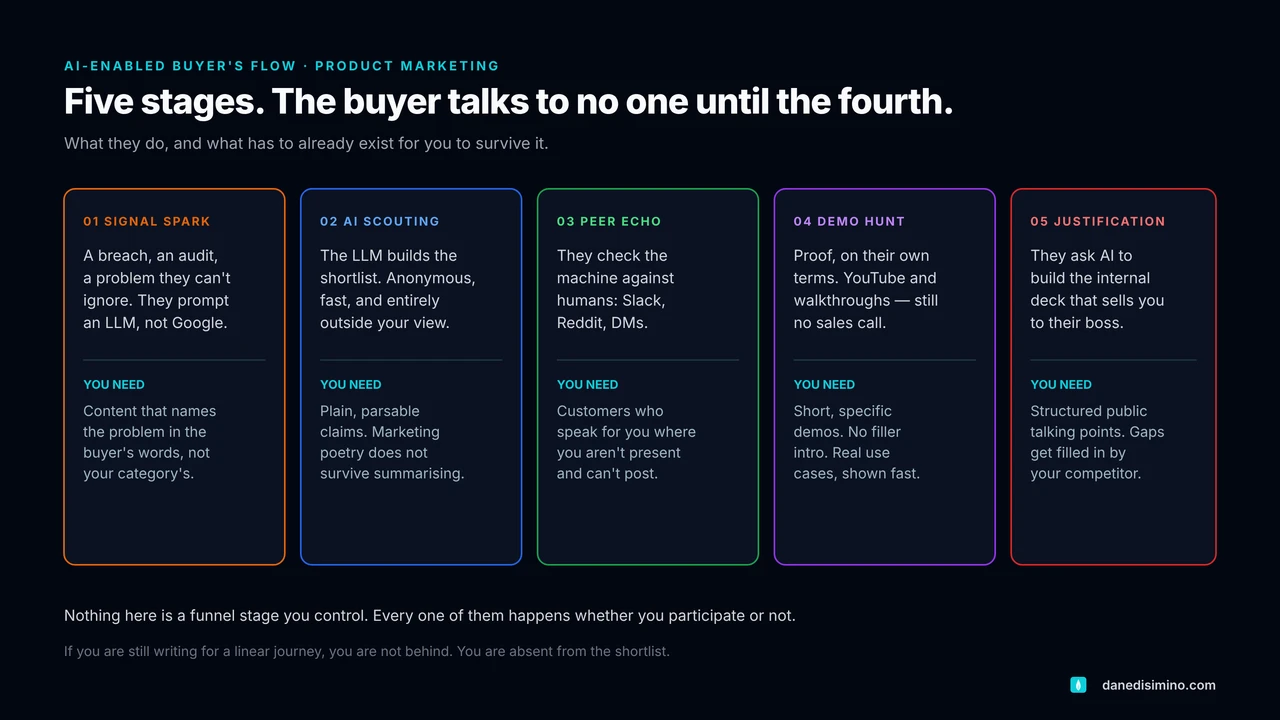
The buyer's journey map was built before buyers had AI. This is what replaced it: five stages where an LLM shortlists vendors, peers validate the machine, and the buyer talks to nobody until stage four. What happens at each, and what has to already exist for you to survive it.
Version 1.0 · Updated Nov 21, 2026
New to cyber product marketing? The free Cyber PMM Academy covers the fundamentals in twenty modules.
The traditional playbook was clean. Start with personas, define pain points, map those to journey stages, fill the gaps with content. Guide the buyer from education to solution to selection. Most of us learned a SiriusDecisions-style framework and built against it for years.
- Loosen status quoThought leadership, industry trendsBlogs and points of view
- Commit to changeBenchmarks and case studiesProof that others moved
- Explore solutionsOverviews, demos, comparisonsSolution briefs and webinars
- Commit to a solutionWebinars, technical diagramsDepth for the technical buyer
- Justify the decisionROI calculators, cost modelsAmmunition for finance
- Select a providerRFP support, pricing, docsThe last mile
In cyber it played across a committee: analysts exploring hands-on, directors weighing operational fit, CISOs judging risk, finance checking ROI. We prioritised personas, mapped content by stage, thought hard about format, and produced what budget allowed.
It worked. It gave structured people a structure. And it still has value the way a museum does — a record of simpler lives.
But buyers don't move through content that way anymore. They don't follow your journey, don't wait for your nurture sequence, and increasingly aren't reading your content at all. They're asking an AI to summarise it.
The short version
The shortlist is built before you know the buyer exists. An LLM makes it, anonymously.
Your messaging has to survive summarising. If it isn't parsable, you don't appear.
Peers audit the machine. One lukewarm Reddit comment removes you.
Demos get watched, not scheduled. No sales assist, no filler intro.
The buyer's internal deck is AI-generated. Your public content is its raw material — or your competitor's is.
- 5
- Stages in the flow
- 4
- Stages before anyone contacts you
- 0
- Of them you control
- 1
- Question that matters: does the model find you?
Stage 1 — Signal Spark
It starts with a problem that can't be ignored: a breach, a compliance change, inefficiency that finally costs something.
They don't visit a vendor site. They don't call a salesperson. They open an LLM and type what tools help detect insider threats, or list the best tools that reduce alert fatigue in a SOC.
This isn't browsing. It's intent-rich, problem-first and immediate — and it frames how they'll think about every solution afterwards, before they've heard of you.
What this requires of you: content that names the problem in the buyer's language, not your category's. A buyer suffering alert fatigue doesn't search for your product category. They describe their Tuesday.
Stage 2 — AI Scouting
Now the buyer uses ChatGPT, Perplexity or Claude to find candidates. They're not googling "best SOAR platforms" the way they were. They ask for comparisons by use case, by budget, by capability — and get back summaries, pros and cons, suggested vendors.
The LLM is now curating the first vendor list. If your messaging isn't parsable, you may simply not appear.
The buyer builds confidence without speaking to anyone. Quiet, anonymous, fast — and white papers and SEO landing pages get leapfrogged entirely.
Stage 3 — Peer Echo
Having narrowed the list by machine, buyers go and check it against humans. Slack communities, subreddits, Discord servers, LinkedIn DMs. Has anyone actually used this? Which one has the better UI?
This is dark social, and it's where trust is built or lost. They want practitioners, not polished marketing. One negative post can remove you from the list you never knew you were on.
What this requires of you: customers willing to speak for you in rooms you aren't in and can't post in. That's advocacy work, and it's slow — which is why it has to start long before the deal.
Stage 4 — Demo Hunt
Now they want proof, still on their own terms. They're not booking discovery. They're hunting demo videos, watching walkthroughs, asking AI to summarise transcripts or compare two products side by side. Does Vendor A integrate with my stack? Can Vendor B suppress alerts in real time?
Your content has to be frictionless, specific and short. No filler intro, no vague promise, no fluff — real use cases shown clearly.
This is where product marketing wins or loses. If your value can't be shown quickly without a sales assist, you may never reach the conversation at all.
Stage 5 — Justification
They're leaning in. They've formed a preference. But before they contact you, they have to convince people internally.
Do they download your deck? No. They ask AI to build one: create a slide comparing Vendor A and Vendor B. They have the model draft the justification memo, the risk summary, the ROI model.
If your public content is clear, structured and rich in usable talking points, it becomes the ammunition in that deck. If it isn't, the model fills the gaps anyway — and it may fill them with your competitor.
What this comes down to
The journey didn't evolve. It jumped tracks.
AI now mediates how problems get recognised, how vendors get surfaced, and how internal decisions get made. Buyers aren't reading your blog, they're summarising it. They're not attending your webinar, they're watching the clipped highlight. They're not waiting to be nurtured — they've already shortlisted.
If you're still building content for a linear funnel, you're not behind. You're invisible.
None of this is hypothetical. It's happening now, quietly, and mostly without you knowing.
The practical response isn't to make more things. It's to make fewer things that survive being compressed, quoted and argued over by people you'll never meet.
Next step
Knowing who you're writing for comes first: Cyber Markets and Buyers. What you write once you know is in Narrative, Positioning and Messaging.
Pathlight
Practitioner notes on narrative and launch, with templates when they are ready.