

PRODUCT MARKETING
Measuring Product Marketing
A Product Marketing Guide
On this page
What to say when a CFO asks why your function exists. Why product marketing measurement is broken, what Sales has that we don't, and four outputs you can defend in numbers instead of listing activities.
Version 1.0 · Updated Nov 21, 2026
New to cyber product marketing? The free Cyber PMM Academy covers the fundamentals in twenty modules.
Imagine you open Slack tomorrow morning and your CFO has sent you a single question: why are PMMs needed? Why do you even exist?
Ouch. But sit with it, because the discomfort is the point. Most of us would start listing: messaging, content, the campaign, the launch, the event, the million things we touched this quarter. The CFO would look back coldly and ask for numbers.
You can't manage what you can't measure.
This is product marketing's biggest unsolved problem, and the one that decides whether the function survives the next efficiency drive.

The short version
If it isn't measurable, it's broken. That applies to our function as much as anything else we'd say it about.
Three things block us: reporting written by other teams, distance from numbers, and no agreed definition of our outputs.
Sales has a bell. We don't, and we've never defined what ringing it would mean.
Stop listing activities. Name the output, then name what it costs the business when it's missing.
Start with four outputs. Market understanding, buyer definition, differentiated messaging, buyer-journey content.
- 4
- Outputs you can defend today
- 3
- Obstacles in the way
- 0
- Agreed industry metrics for PMM
- 1
- Question a CFO will actually ask
What it would be like if we fixed this
Before the obstacles, it's worth being specific about the prize, because this is not a measurement exercise for its own sake.
- PromotionsBased on performanceMeasurable results instead of visible heroics and dive-and-catch rescues.
- New PMMsKnow what good looks likeEntry-level people can see the criteria and their own priorities.
- Fire drillsFewer of themMeasured work crowds out whatever shouted loudest this morning.
- CareersMore fulfillingLess confusion about how you're doing is worth more than most perks.
- CalendarsLighterWhen the function's scope is clear, it's obvious which calls aren't yours.
That last one is my favourite and it isn't a joke. A measured function can decline a meeting with a reason.
Why it's broken now
Reporting distance. Someone else's team usually owns marketing reporting. They present MCP and MQLs and a dozen other acronyms, having spent almost no time talking to PMMs, with nothing at the individual product level. So the PMM audience tunes out. We golf-clap politely and leave with no idea whether we had anything to do with the result.
Number distance. Conversations between finance and product marketing are awkward because our measurement has stayed largely subjective. We've been disconnected from numbers for so long that both sides expect the conversation to go badly.
No output definition. Our outputs have no standard definitions, so there's nothing stable to build a metric on. Sales has it easier: Sales produces revenue. Somebody once told me "everything is Sales," and I take the point, but we are not measured the same way at the end of the quarter.

Sales gets it, and I envy them for it
I spent a stretch in inside sales over a decade ago. There was an actual bell on the floor. You either rang it or you didn't. Did you hit quota this month? Then you still had a job.
It was brutal, and it sometimes felt inhumane. But everyone knew exactly where they stood, and I've come to think that clarity is the more humane arrangement. I had a number. Everyone knew my number and how close I'd come.
Product marketing is the opposite. We don't have a number. So we react to the events of the day instead of working toward something we agreed on in advance.
OKRs help, but they get undermined by unquantifiable objectives. "We will build 25 product assets in Q4" is countable and nearly meaningless — it has no relationship to a financial outcome. Twenty-five of the wrong assets is a worse quarter than three of the right ones.
So: when does a PMM ring the bell? When marketing-contributed pipeline grows? Maybe. But when MCP soars, no PMM feels it. Nobody walks to the bell.
What's missing is a line connecting product sales, product adoption and business growth back to our function. Without it, confusion wins, and talented people leave the field or never enter it.
Answer the CFO with outputs, not activities

Here's the shape of the better answer. Start politely — thanks for asking, I'd welcome the chance to explain — then give outputs, each with the consequence of its absence. The consequence is what a CFO is actually buying.
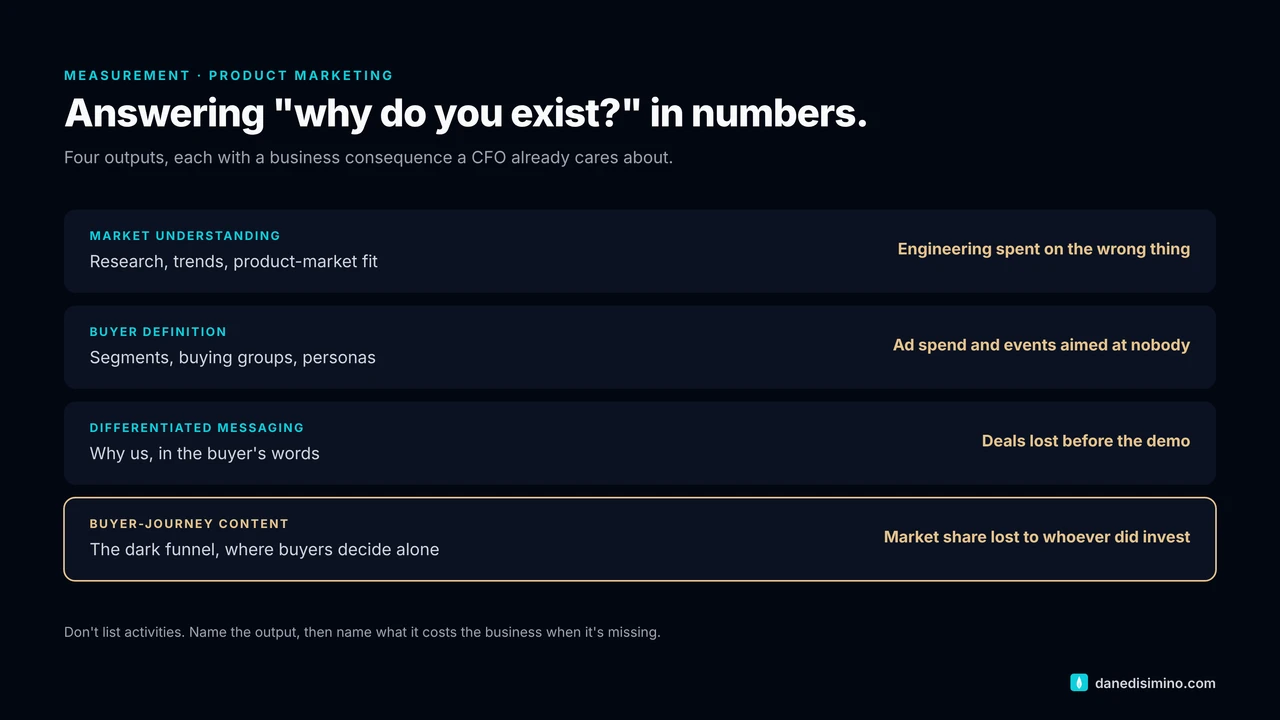
Driving market understanding. I continually research and analyse the trends and drivers in the markets our products sit in. Without it the business suffers poor product-market fit, which means engineering money spent building a solution in search of a problem. Look at how many startups rise and fall in this industry; most of them had no true market understanding at the outset. That is the risk I remove.
Defining buyers. Segments, buying groups and personas inside the ideal customer profile. This is what makes advertising targeted, media selection sane, trade show investment defensible, and leads good enough for Sales to convert. Without it we spend real money reaching nobody in particular.
Creating differentiated messaging. Clarity on why a customer should choose us over the alternative. It won't rescue a bad product, but a good product with bad messaging loses deals it should win and never makes shortlists it should make. Good messaging means a buyer already understands us before they raise their hand.
Building buyer-journey content. Most buyers now research through search, our site and free video — the dark funnel, where they decide without talking to anyone. If we don't meet them there, the competitors investing in it take share, and then come for our existing customers.
The same exercise repeats for competitive intelligence, analyst relations, peer reviews, events, testimonials and sales enablement. Four is enough to start.
As a CMO I worked for used to say: we need fewer random acts of marketing. Measurement is how you tell the difference between a random act and a deliberate one — which is also, not coincidentally, what adopting AI across the function requires.
What this comes down to
Nobody is going to hand product marketing a scoreboard. Sales got one because revenue is easy to count, not because anyone cared more about Sales.
So define your outputs before someone else defines them for you. Attach each one to a consequence the business already understands. Then measure what you can, honestly, even when the first numbers are unflattering.
The alternative is staying subjective, and a subjective function is the first one a CFO looks at when the word "efficiency" starts appearing in meetings. Being measurable is not bureaucracy. It's the argument for your own existence, prepared in advance of the day you need it.
Next step
Three of the four outputs above are covered in depth: Cyber Markets and Buyers for market understanding and buyer definition, and Narrative, Positioning and Messaging for the message itself.
Pathlight
Practitioner notes on narrative and launch, with templates when they are ready.