

PRODUCT MARKETING
Team of Teams
A Product Marketing Guide
On this page
How to lead a launch when nobody reports to you. McChrystal's team-of-teams model applied to product marketing: adaptability over efficiency, shared context over permission, and why the resources you need will always sit outside your reporting line.
Version 1.0 · Updated Nov 21, 2026
New to cyber product marketing? The free Cyber PMM Academy covers the fundamentals in twenty modules.
In thirteen years in this business, nobody has ever reported to me on paper. Not once. And yet the launches went out, the campaigns ran, and the content got built — by people in brand, campaigns, content, sales, product, field and web who had no obligation to do any of it for me.
Most of them didn't know who I was before I sent the first introduction message.
I work at Cisco now, which is north of eighty thousand people, so I'll admit a bias toward large organisations. But this was just as true at startups and scaleups, where the "other team" was an agency, or a contractor, or the uncomfortable fact that one person was covering four functions.
So when I read General Stan McChrystal's Team of Teams, the question that stuck was: could this apply to product marketing?
The short version
Adaptability beats efficiency when the ground keeps moving, which in cyber it always does.
Shared context beats permission. Teams move fast because they know what matters, not because they got approval.
Trust scales; oversight doesn't. Adding layers slows things down and calls it governance.
Your team may include agents now. The orchestration rules don't change — they get stricter.
You are not the hero. PMM centres the mission, not itself. That's the part most of us resist.
- 0
- People who have ever reported to me
- 80k+
- Employees at my current employer
- 95%
- Of important projects needing someone outside your line
- 1
- Mission everyone is actually on
What team of teams actually means
The core idea is simple: traditional org charts break under modern complexity. You stop winning by optimising for efficiency and start winning by being adaptable.
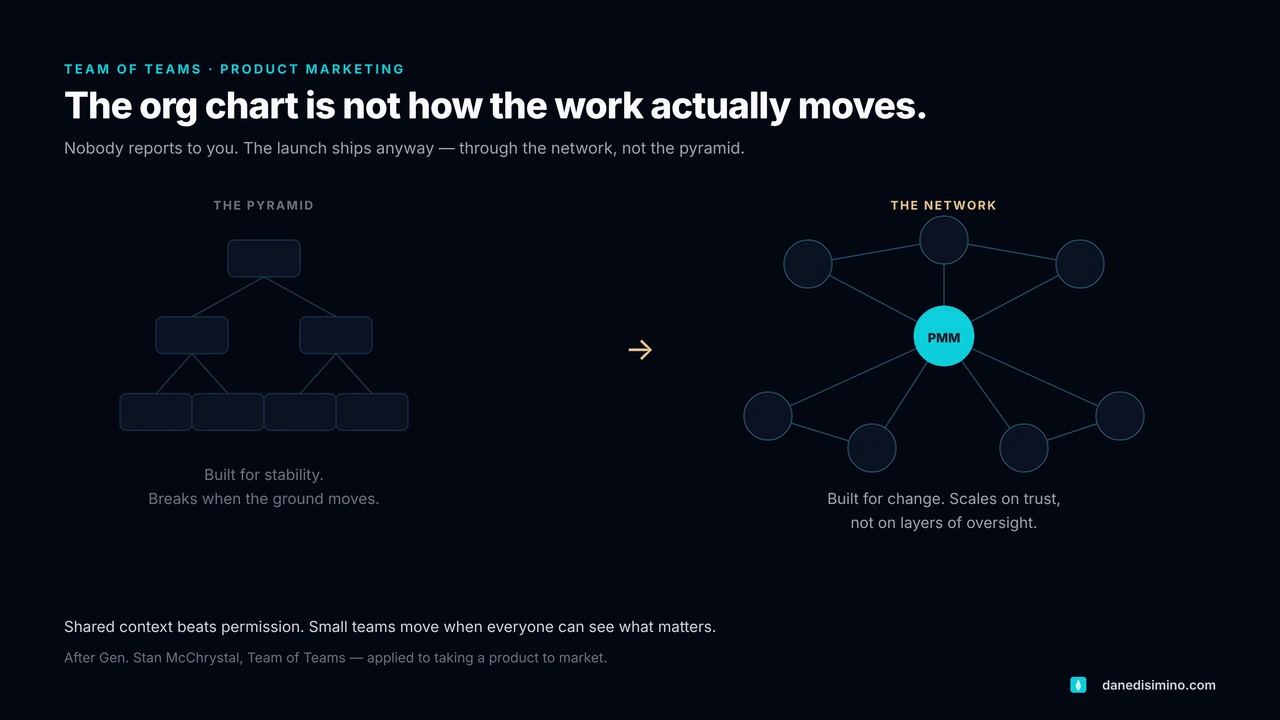
- Adaptability over efficiencyThe old model assumed stabilityClear roles, chains of command, tight process. All of it falls apart when the environment keeps changing.
- Shared consciousnessEveryone gets the same contextMcChrystal replaced slow command-and-control with real-time information sharing, so small units could act without waiting.
- Trust over controlLayers of oversight don't create speedLeaders become orchestrators rather than bottlenecks: set the mission, ensure alignment, let the team work out the how.
- Networks over pyramidsThe org becomes a living thingTeams connect across disciplines and priorities, solve problems in real time, and self-organise. Flatter, and smarter.
Replace rigid control with fluid coordination. That's a playbook for leading in complexity, whether you're running a combat unit or taking a cybersecurity product to market.
Your team may include agents now
Thanks to agentic AI, a team isn't necessarily people. In a lean organisation it might be a mix of humans, workflows and agents — or four people covering all of marketing while each runs five agents.
A content agent drafting posts. A research agent summarising customer behaviour. A competitive agent scanning the market overnight.
They aren't teammates in the human sense, but they're on the team, and the same rules apply: clear objectives, defined inputs and outputs, explicit responsibilities, mutual accountability.
Leading without authority
Most product marketers are individual contributors. Our names don't sit on an org chart with a team underneath. We don't hold budget. We can't assign work.
That doesn't mean we don't lead.
We lead by influence. By clarity. By removing ambiguity. By keeping a project moving while everyone else stalls in confusion. We're the stabiliser in the chaos — and in cyber there is always chaos, because people quit constantly, roadmaps shift, and layoffs arrive.
Nobody trains for this. Universities don't run a course called chaos simulation for product marketers, designed by people who've actually lived it. Maybe someone should.
The practical reality: in most go-to-market efforts, nearly all the resources you need sit outside your reporting line, and that share grows with the size of the organisation. Design, product, sales engineering and demand generation all have their own priorities. You will never lead them through hierarchy. You join them on a shared mission through trust, speed and sharp execution.
You are not the hero
This is the part most product marketers resist, so I'll say it plainly: in this model, PMM is not the hero.
We play a specific position on a team, like everyone else. We don't centre ourselves; we centre the mission, and the mission is almost always the product's success in market, measured in customer growth and adoption.
Yes, we sit at the intersection of product, sales, market and customer experience. Yes, part of the job is making the right things happen in the right order across the right teams.
But sometimes the job is to take a back seat and pass the ball. The constant struggle to feel in control needs to stop. To operate in a fluid system you have to fit into the network around you, not sit above it.
Our part, specifically? We're the nexus into the market and the customer, so we define and nail the product's in-market narrative. Narrative-to-audience is the critical piece. Get that right and the other dominoes fall.
What this comes down to
The org chart will tell you who reports to whom. It will tell you almost nothing about how a launch actually happens.
Launches happen through a network of people who don't owe you anything, who are busy, and who will help if they trust you and can see the mission. Build that, and the lack of authority stops being the obstacle you thought it was. It was never the obstacle. Not knowing how to work without it was.
Next step
The narrative that unifies a team of teams is built in Narrative, Positioning and Messaging. The closest of those relationships gets its own guide: Working with Product Management.
Sources
Pathlight
Practitioner notes on narrative and launch, with templates when they are ready.