

PRODUCT MARKETING
Working with Product Management
A Product Marketing Guide
On this page
The most important working relationship a product marketer has. The four ways PMM and PM pairs actually operate, the five pressures bearing down on a cyber PM, and five things you can do to make the partnership work.
Version 1.0 · Updated Nov 21, 2026
New to cyber product marketing? The free Cyber PMM Academy covers the fundamentals in twenty modules.
If you want to go fast, go alone. If you want to go far, go with your PM.
Your most important working relationship as a product marketer is with your product management counterpart. Get it right and you get more customers, more revenue and more market share. Get it wrong and you'll spend your quarters guessing at dates and arguing about whose fault the launch was.
This is what I've learned working with more than thirty PMs across seven cyber vendors and dozens of launches. It was not always smooth. But I've also seen what a real PMM and PM tandem can do, and it's the difference between a product that lands and one that merely ships.
The short version
Four styles exist. Find yours honestly; most pairs aren't trailblazers and that's normal.
The PM job is brutal. Five pressures sit on them that have nothing to do with you.
Be product capable. If you can't demo it, you're a nuisance with questions.
Take the seat. Nobody hands a PMM the outside-in role; you take it.
Co-present. The strongest content either of you will make is the content you make together.
- 30+
- PMs worked with
- 1:3
- Typical PMM to PM ratio
- 5
- Products the average PMM carries
- 2
- Kinds of expertise, one product
Four ways this pairing actually works
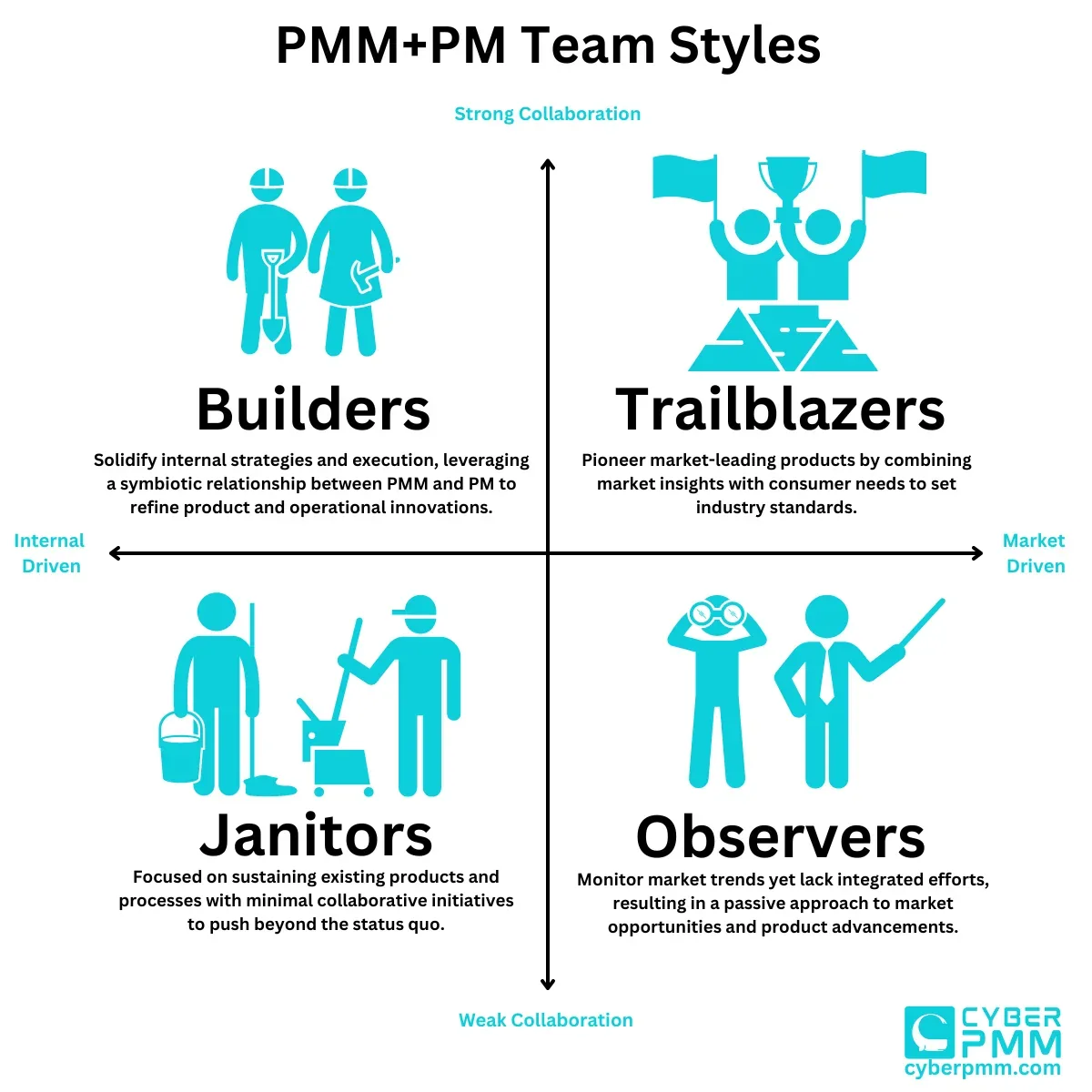
PMM and PM pairs land somewhere on two axes: market-driven versus internal-driven, and strong versus weak collaboration.
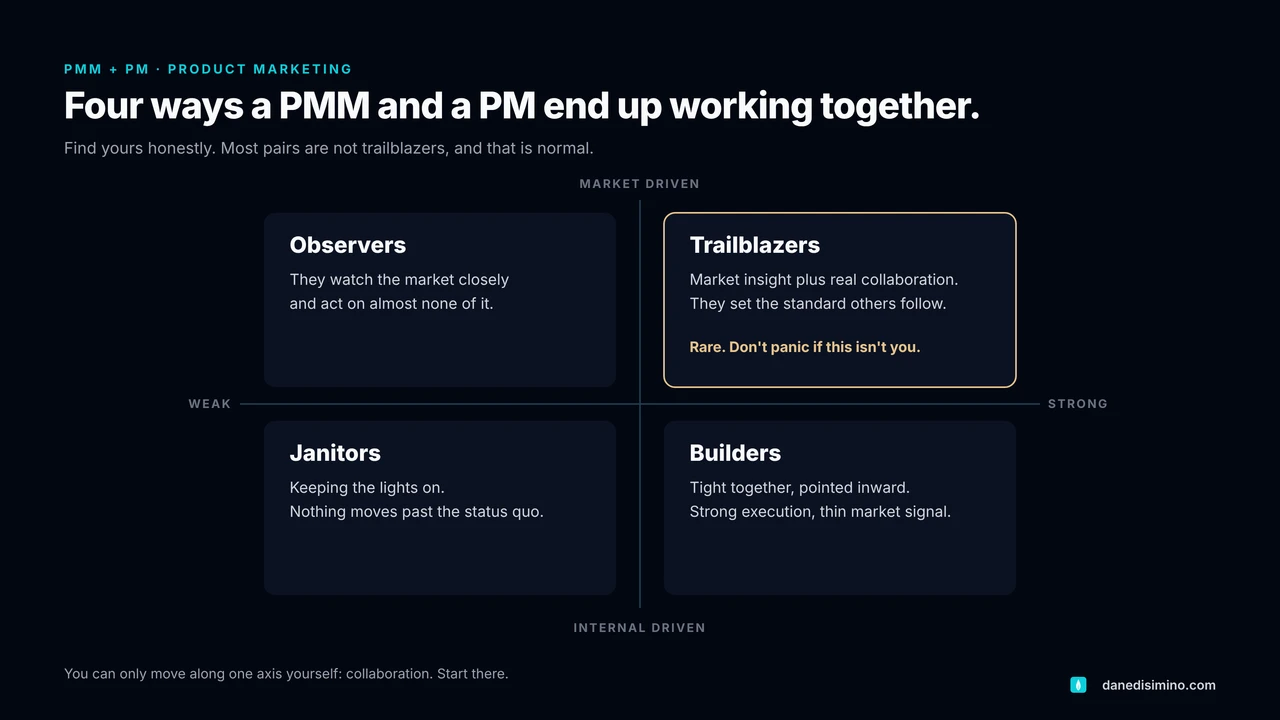
Trailblazers — market-driven, strongly collaborative. They combine market insight with customer need and set the standard other vendors follow.
Builders — internal-driven, strongly collaborative. Genuinely symbiotic, sharpening product and operational execution, but pointed inward.
Observers — market-driven, weakly collaborative. They track the market closely and act on almost none of it, because the two halves never meet.
Janitors — internal-driven, weakly collaborative. Sustaining existing products and processes, nothing moving past the status quo.
Before you judge yourself for not being a trailblazer: it's rare. And one reason has nothing to do with you.
Five pressures on a cyber PM
Understanding these will change how you read a PM's behaviour, and most of what looks like obstruction is one of them.
They sit in an impossible organisational position. A PM is the nexus between go-to-market expectations, customer commitments and engineering reality. On a given day they go from a sprint meeting to an escalated customer call to an enablement session, making consequential decisions in each.
They have to build it and secure it. Every PM should build secure products. For a security vendor the stakes are different: if our own product isn't secure, what exactly are we claiming in the market?
Market-driven roadmaps are hard. "Where's the roadmap?" is the question they hear most. Roadmaps drive engineering tasks and customer expectations at once. A PM disconnected from the market builds one that sets the company off course, and the correction costs years of innovation debt while the software gets rewritten toward where customers actually were.
Random demands blow it up. A PM can have a genuinely good roadmap, and then a new CPO arrives and reshuffles everything. Or one large customer makes enough noise that the CEO personally sponsors a feature. One enterprise needing something does not make it a market opportunity, and the PM is the one holding that contradiction.
Responsibility without authority. A date on a roadmap does not mean engineering will hit it. PMs hold limited sway over engineering teams pulled in a hundred directions, and in many orgs engineering doesn't report to them at all. So the dates they give you and Sales are estimates. When launches slip repeatedly, the PM loses credibility for a war over resources they never had the power to win.
Read that list again and notice: none of it is about you. Most PMM frustration with PMs is a misreading of one of these five.
Five things that make the partnership work

1. Know your markets, buyers and competitors cold. When a conversation drifts into messy internal realities, your job is to bring market context back into the room. That means analyst reports you know like the back of your hand, buyer persona profiles that let you argue from the buyer's position, and genuine knowledge of your top three competitors. Decisions made on internal opinion, an executive's gut, or one customer's demands fail. Having the outside-in evidence organised and shareable is how you prevent that, and better positioning falls out of it.
2. Take your seat at the table. Many PMMs hang back and avoid weighing in with PM. Don't. Speak up, and barge in where you have to. You'll get into the decisions that matter, and you'll hear about releases early enough to plan, which means fewer fire drills later. Leaning in is what gets you plugged in.
3. Respect their time, and be product capable. The 2023 State of Product Marketing Report put the average PMM-to-PM ratio at 1:3, with a single PMM covering five or more products. Everyone is stretched. So don't schedule more cadence calls than the work needs, and be product capable at a 101 and 102 level: log into the product, give the demo, know the features. Check the FAQs, decks and demo videos before taking a basic question to an over-extended PM. If you keep running to them for things you could have looked up, you'll be treated as a nuisance, because you are one.
4. Remember you're on the same side. It's easy to lose in the daily grind. PMMs decide engineering realities are irrelevant; PMs decide a marketing initiative is. You are both trying to get customers using the same product and win the same market. Keep asking the outside-in questions however uncomfortable they get — and extend the same empathy back toward engineering constraints. A PM shouldn't treat market context as an attack, and a PMM shouldn't treat resource limits as an excuse.
5. Co-present on the big forums. The strongest content either of you makes is the content you make together. At Splunk's .conf23 I presented a session alongside the PM for the product: I opened with the market perspective, he went inside the product with live demos. We built the message jointly, rehearsed in person, and delivered it to more than a hundred users in Vegas. We did the same on a launch webinar. Market context from PMM, in-the-product depth from PM — that balance is what makes content land.
What this comes down to
You'll be fortunate to find a PM who is collaborative and open. When that PM meets a genuinely market-driven PMM, there's very little the pair can't do.
You bring market expertise. They bring product expertise. Neither is sufficient, and the product fails quietly when the two never meet — not dramatically, just a roadmap built on internal opinion and messaging built on a roadmap nobody validated.
Ignore each other at your own peril. Work together and you'll both go further.
Next step
The market evidence that makes you useful in these conversations is in Cyber Markets and Buyers. What you do with it afterwards is in Narrative, Positioning and Messaging.
Pathlight
Practitioner notes on narrative and launch, with templates when they are ready.