

PRODUCT MARKETING
Defining Your Shapes
A Product Marketing Guide
On this page
The eight recurring pieces of product marketing work, and why defining them is the prerequisite for automating any of them. Market understanding, personas, prioritisation, messaging, testing, journey maps, content templates and production workflows.
Version 1.0 · Updated Nov 21, 2026
New to cyber product marketing? The free Cyber PMM Academy covers the fundamentals in twenty modules.
Ask a product marketer what they did last week and you'll get a list of unrelated things. Messaging on Monday. An event keynote on Tuesday. An analyst briefing Wednesday. A sales escalation that ate Thursday.
That's the job, and the unpredictability is not going away. But there's a mistake hiding inside it: because the order is random, we treat the work as though it were too, and improvise each piece from scratch every time.
It isn't random. There are a limited number of recurring pieces. I call them shapes, because the sequence they arrive in is unpredictable while the shapes themselves never change.
Carpenters have a set of materials. Musicians have twelve notes. Chemists have a periodic table. Every profession works with a bounded set of variables. Why would ours be different?
The short version
The order is random; the shapes are not. Eight pieces cover most of the work.
Definition comes before automation. Every useful prompt points at a template or a standard you already wrote.
Borrowing wholesale doesn't work. Cyber has its own idiosyncrasies; take ingredients, not recipes.
Undefined work gets judged on appearances. A 3am Slack message is not a measure of quality.
Start with one shape. Define it properly, use it twice, then do the next.
- 8
- Recurring shapes
- 0
- That can be automated before they're defined
- 1
- Place to start, not eight
Why this comes before the AI conversation
Everyone wants the assistant that drafts the brief. Fine — here's a realistic prompt for one:
Create a 500-word product brief using this template, drawing on this messaging brief for guidance.
Read it again and notice what it depends on. A template. A messaging brief. Both of which someone had to define first.
This is the part that gets skipped. An assistant with no standards doesn't produce good work faster; it produces vague work faster, and vague work at volume is worse than less of it. You're training a student before you've learned to throw the punch yourself.
So the first move isn't picking a tool. It's writing down what good looks like for each shape — which is also, conveniently, the thing that makes your work measurable.
Yes, cyber really is different
The reasonable objection: can't we take product marketing processes from other industries?
Partly. I've watched well-meaning PMMs from other sectors post advice on LinkedIn that simply doesn't survive contact with this industry. Same with training courses — thoughtfully built, and rarely implementable on the job as written.
A template that works beautifully in manufacturing or finance probably won't fly here. Training in karate is excellent, and it still won't win you a kung fu tournament.
That's not a claim that cyber is harder or better. It's that the buyers, the committee, the analyst machinery, the pace of category invention and the mistrust baked into the industry all change the shape of the work. Borrow ingredients from every standard you can find. Don't copy the recipe.
The eight shapes
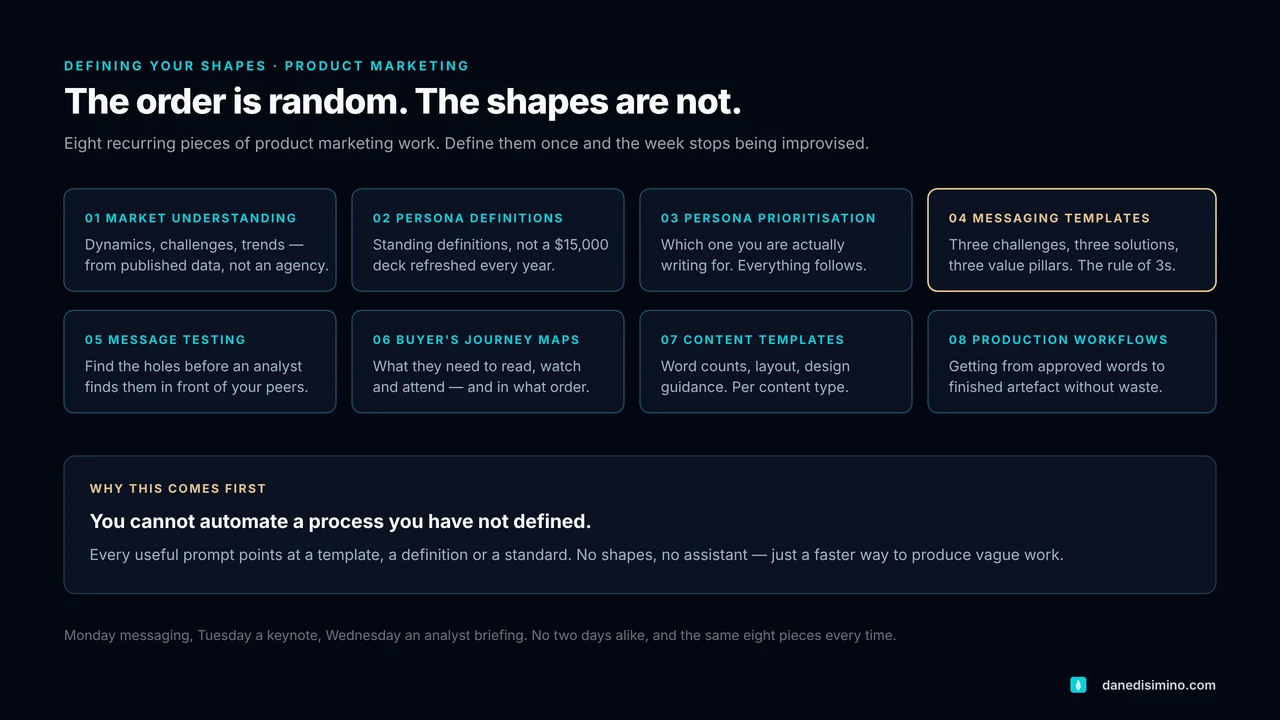
1. Market understanding. A defined process for researching market dynamics, customer challenges and current trends. Most of this data is already published — you don't need to contract it out and wait months for someone to hand it back.
2. Persona definitions. Standing definitions rather than the annual PowerPoint refresh. The era of paying an agency fifteen thousand dollars for a security analyst persona document should be over: the definitions are widely available and the personas themselves are publishing their frustrations on social platforms daily.
3. Persona prioritisation. A repeatable way to score a product against your personas — CISO, compliance manager, SOC director, security engineer, analyst. Which one are you actually writing for? Everything downstream depends on the answer. The Persona Prioritisation Matrix I learned from Forrester, originally SiriusDecisions, does this well. What it shouldn't be is a static document rebuilt by hand each year.
4. Messaging templates. A library covering any situation: a product, a feature, a whole portfolio. Each with target persona, word counts, layout and value pillars. Build them on the rule of 3s — three customer challenges, three solutions, three value statements — producing three value pillars that become the source for everything else.
5. Message testing. It's easy to love your messaging while it's just you and the document. The fun starts when you share it, and it peaks when an analyst dismantles it in front of your peers. Testing is how you find the holes first, on your own schedule.
6. Buyer's journey maps. What buyers need to read, watch, hear and attend, and in what order. These get treated as a luxury — you build one, show the team, and someone scans it for three seconds and says nice map, but you didn't need to do that. Aligned to persona prioritisation, it's the model connecting your target to the content that actually moves them.
7. Content templates. Once the above exist, define the content mix, with each item carrying word count, layout and design guidance. This is what makes "generate a content mix for product X from source Y" a reasonable request rather than a wish.
8. Production workflows. Getting from approved words to finished artefact — agency, Adobe, Canva, whatever you use. I've been through enough production cycles to find the time and cost genuinely astonishing. This is the shape with the most waste in it and the least standardisation, and probably the biggest prize.
What this comes down to
This is a complex game with a bigger board and more obstacles than most jobs. But there are only so many shapes, and you already know what they are — you've just never written them down, because the next thing was always falling.
Define the shapes and three things happen. The week becomes repeatable even when the order isn't. The work becomes measurable, because there's a standard to measure against. And automation becomes possible, because there's finally something to train against.
Skip it, and the assistant you were excited about just helps you improvise faster.
Next step
The first three shapes are covered in depth in Cyber Markets and Buyers. Shapes four and five are in Narrative, Positioning and Messaging. Why defining them makes you measurable at all is in Measuring Product Marketing.
Pathlight
Practitioner notes on narrative and launch, with templates when they are ready.